
The Top 10 Reasons Why Business Owners Need to Meet With a CPA This Summer

A few days ago here on the SWC blog, we shared why it’s important for individual taxpayers to meet with their CPA over the summer. It basically boils down to being prepared. No one wants to learn in the first quarter of 2025 that their state or federal tax liability could have been dramatically reduced or altogether eliminated had they just met with their CPA for one hour in June, July, or August.

As a business owner, the same logic applies. Below are the top 10 reasons why you as a business owner, entrepreneur, or an investor with an ownership stake in a business should schedule a mid-year meeting with your CPA this summer.

Marni Walker of SWC

  1. Take Advantage of Depreciation Tax Breaks: Current tax laws offer generous depreciation deductions for qualifying assets. By discussing your plans with us, we can help you maximize your Section 179 deductions and first-year bonus depreciation, potentially saving you significant amounts on your tax return.
  1. Time Business Income and Deductions: Strategically timing your business income and deductions can lead to substantial tax savings. Whether it’s deferring income or accelerating expenses, we’ll help you make the right moves to align with your financial goals.
  1. Maximize the Qualified Business Income (QBI) Deduction: The QBI deduction can be a significant tax saver for owners of pass-through entities. We’ll ensure you understand the complexities and limitations of this deduction, helping you plan to maximize your benefits.
Continue reading… Continue reading… Continue reading…

The Pros and Cons of a Cost Segregation Study

By |2023-02-10T17:00:38-08:00February 10, 2023|Categories: Real Estate|Tags: , , |0 Comments

If you own real estate, or you’re interested in investing in real estate as a strategy for building or increasing your net worth, then you need to know about cost segregation.

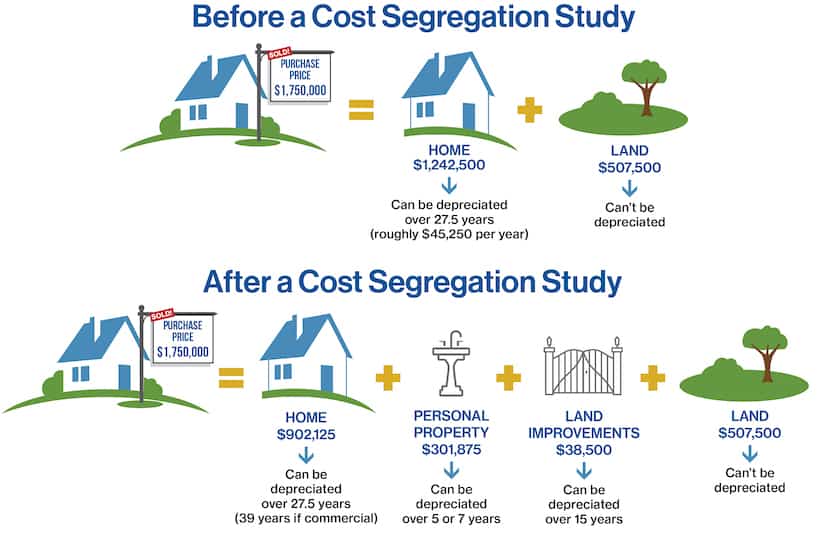
Cost segregation study illustration for residential propertyCost segregation is a technique recommended by a tax planning firm that specialize in helping its clients reduce their taxes and increase their net worth. Cost segregation allows property owners and real estate investors to reallocate the costs of a property from long-term assets (which have a useful life of 27.5 years or more) to shorter-lived assets (which have a useful life of less than 27.5 years).

This reallocation can provide significant tax benefits because shorter-lived assets are eligible for accelerated depreciation.

Depreciation 101: Depreciation is an accounting technique that distributes the cost of tangible assets such as real estate over their useful lifespan. It reflects the portion of an asset’s value that’s been utilized, allowing you to gradually pay for and generate revenue from an asset over a specified period of time.

When a property is built or purchased, the costs of the property (such as construction costs or the purchase price and cost of improvements) are typically allocated to the building and land as long-term assets. However, many of the items within a property (such as carpeting, lighting fixtures, and appliances) have a shorter useful life and can be classified as personal property. By identifying these shorter-lived assets and reclassifying them as personal property, the costs associated with them can be depreciated over a shorter period, resulting in a larger tax deduction in the early years of ownership.

Starting With a Cost Segregation Study

To add cost segregation to your tax planning approach, start by ordering a cost segregation study from a reputable firm. Here at SWC, we work with several of these firms and can recommend the right one for your particular circumstances and objectives.

When you engage a firm in a cost segregation study, a cost segregation specialist identifies and reclassifies the costs of your property, typically by examining the property and its invoices, blueprints, and other documentation. The study then allocates property costs to real property or personal property. Findings from the study can then be used by your tax planning firm — in this case, SWC — to calculate a one-time catch- adjustment. That’s because the IRS allows the Continue reading… Continue reading… Continue reading…

Understanding Small-Business Tax Deductions

As part of an effort to mitigate the effects of the spread of the coronavirus known as COVID-19, the Internal Revenue Services has chosen to delay the April 15, 2020 tax filing deadline for most individual taxpayers and businesses to July 15, 2020. Regardless of the deadline, one thing that isn’t expected to change anytime soon is what a business can and cannot claim as a tax deduction. And in today’s post, we offer insight into exactly that — what small businesses can and cannot deduct, regardless of the tax filing deadline.

A deduction (or write-off) is an expense or portion of an expense subtracted from your company’s gross income that reduces the income on which taxes are calculated. Every dollar you claim as a deduction is a dollar less that is subject to federal, state, and local income tax and self-employment tax (Social Security and Medicare).

Small Business Deductions Image

For example, if your effective federal income tax rate is 25 percent, and you pay 15.3 percent in self-employment tax and 5 percent in state and local income tax, every thousand dollars less you report in taxable income is over 450 dollars you save in taxes: (0.25 + 0.153 + 0.05) x $1,000 = 0.453 x $1,000 = $453.

The Tax Cuts and Jobs Act (TCJA), which became effective in 2018, made it less advantageous for taxpayers to itemize personal deductions. However, if you own a small business — such as a sole-proprietorship, limited liability company (LLC), or partnership — you can deduct a broad range of business expenses to lower the taxable income you earn from that business.

Here are a couple tips for claiming business deductions without getting into legal trouble:

  • Seek confirmation from a tax specialist or certified public accountant (CPA) before claiming any business expense as a deduction.
  • Keep accurate, detailed records, including invoices and receipts for all business expenses. (Your CPA can help you find accounting packages and apps to simplify your record-keeping.)

In the following sections, we present a long list of common small-business tax deductions. Continue reading… Continue reading… Continue reading…

Go to Top
