
Catching Up With Recent Changes at the IRS

By |2025-11-14T13:07:03-08:00November 14, 2025|Categories: Taxes|Tags: , , |0 Comments

That old adage about death and taxes deserves another look. Since 1913, the U.S. tax code has kept changing, and the Internal Revenue Service (IRS) issues updates every year that can affect you. Of course you can always rely on the experts here at SWC to keep you posted on recent changes.

Like what, you ask. Here’s just three recent changes that have popped up on our radar screen that you’ll want to know about:

  • The rollout of the newly created Form 1099-DA, which expands reporting requirements for digital asset transactions
  • Increased liability for employers who use third-party payers to process their payroll transactions
  • The discontinuation paper check refunds to individual taxpayers

In this post, we highlight each change in turn, whom it is likely to impact, and how to navigate the new rules and procedures. The goal, of course, is to leave you well prepared for tax season 2026. Our next post will focus on additional changes you need to be aware before we meet with you during your October – December 2025 Year-End Tax Projection meeting.

Photo of IRS Building

First up, there’s going to be a new IRS form for reporting digital asset transactions.

New Form for Reporting Digital Asset Transactions

To formalize the reporting of digital-asset transactions and improve compliance, the IRS has developed a new Form 1099-DA. According to the IRS, a digital asset is any computerized representation of value recorded on a cryptographically secured distributed ledger like the blockchain or any similar technology. Digital assets include the following:

  • Cryptocurrencies, such as Bitcoin, Ethereum, Solana, Dogecoin, and others that can be used as payment or held as investments
  • Stablecoins, such as Tether, USDC, Dai, Ethena USDe, and others that are digital tokens attached to the value of fiat currencies
  • Non-fungible tokens (NFTs), such as Render, Immutable, FLOKI, and GALA, all of which are unique digital certificates of ownership tied to digital art, collectibles, or games
  • Tokenized assets that represent ownership in real-world assets, such as real estate shares or commodities

As a taxpayer, here’s what you need to know about digital assets: Continue reading… Continue reading… Continue reading…


Avoid Tax Sticker Shock: Review Your Income and Withholdings

By |2022-03-22T16:46:44-07:00March 22, 2022|Categories: Taxes|Tags: , , , |0 Comments

Nobody likes to get whacked at the end of the tax year with a higher-than-expected income tax bill or a smaller-than-expected refund, but that’s what happens when you don’t have enough money withheld from your paychecks or aren’t paying enough in estimated taxes.

The United States operates a pay-as-you-go tax system, which means you as a taxpayer are expected to pay taxes on your income as you earn it, not just at the end of the year. If you owe too much at the end of the year, the government charges you a penalty. You can think of it as interest on what you underpaid for the time you underpaid.

To avoid a nasty surprise when you’re preparing your tax return at the end of the year, review your income expectations and withholdings (and estimated taxes) at the beginning of the year and adjust as needed. This is especially important if you have any self-employment or investment income or income from other sources.

Using the IRS’s Tax Withholding Estimator

To help you determine your correct tax withholding, the Internal Revenue Service (IRS) provides an online Tax Withholding Estimator that you can use for free to determine whether you need to do one of the following:

  • Complete a new Form W-4, Employee’s Withholding Allowance Certificate and submit it to your employer
  • Make or modify your estimated tax payment to the IRS

Before you start, gather your income documents, including these: Continue reading… Continue reading… Continue reading…
Freelancers and Contractors Accepting PayPal, Venmo, and Crypto — What You Need to Know

By |2022-01-25T16:18:08-08:00January 25, 2022|Categories: Business Advice, Independent Contractor|Tags: , , , |0 Comments

We all accept the fact that each new year ushers in new or updated tax rules, regulations, deadlines, rates, and thresholds. However, changes for 2022 are most remarkable because of their impact on freelancers, independent contractors, and any business that accepts payment via an e-payment platform such as PayPal or Venmo.

Top among these changes affecting many of the above-mentioned freelancers, independent contractors, or businesses is the use of hard, soft, cold, hot, mobile, or digital wallets to accept payments available through cryptocurrencies, which are now perhaps stable enough for businesses to consider accepting.

Crypto and the IRS graphic

In this post, we give you a heads up on what to expect in 2022 so you won’t be blindsided at any point during the year ahead. Below, we offer insights into each of the following changes for 2022:

  • New reporting rules for payment apps
  • What you need to know about accepting cryptocurrencies
  • Upcoming tax deadlines
  • Changes to the standard deduction
  • Marginal tax rates for 2022
  • Increase in the earned income tax credit

To avoid any unpleasant surprises at year’s end, now is the time to get up to speed on the key changes below and adjust your tax and financial planning accordingly.

New Reporting Rules for Payment Apps

To reduce the amount of unreported taxable income flowing through e-payment platforms such as PayPal, Venmo, and Cash App, the Internal Revenue Service (IRS) is requiring such platforms to report each user’s business transactions if they exceed $600 for the year for goods or services.

The prior threshold for reporting was 200 transactions per year or a combined total of at least Continue reading… Continue reading… Continue reading…
How to Handle a Taxpayer Identification Verification Request from the IRS

By |2021-06-30T12:26:24-07:00June 30, 2021|Categories: Fraud Prevention|Tags: , |0 Comments

Receiving an unexpected letter from the Internal Revenue Service (IRS) is seldom a good thing, and when it’s asking you to verify your identity, your brain heats up with red flags, warning sirens, questions, and concerns. Have I fallen victim to identity theft? Is this a phishing scam? Are con artists now posing as IRS agents to get my personal information? What should I do?

First and foremost, don’t panic. Most people’s instinct when they receive such a letter is to click a link (if they received it via email) or visit the website or call the phone number provided in the letter to find out what it’s about. And if the letter is part of a phishing scam, that’s exactly what the con artist wants you to do.

Is This Letter Really From the IRS?

If you received a notice out of the blue from the IRS via email, text, or even through one of your social media accounts, it’s probably not from the IRS. That’s not how they roll. When the IRS needs to contact a taxpayer, they typically do so in the form of a printed letter delivered by the U.S. Postal Service (USPS).

If you received a printed letter in the mail, examine the envelop and letter closely for signs of fraud, including the following: Continue reading… Continue reading… Continue reading…

The Return of IRS Form 1099-NEC

Over the past 40 years or so, large and small businesses alike have been using Form 1099-MISC (short for miscellaneous income) to report payments of $600 or more in a calendar year to independent contractors, freelancers, sole-proprietors, and other self-employed individuals. Prior to that, these same businesses used Form 1099-NEC (short for non-employee compensation) for that purpose.

Well, the IRS (Internal Revenue Service) is turning the clock back to the 1980s with the return of Form 1099-NEC.

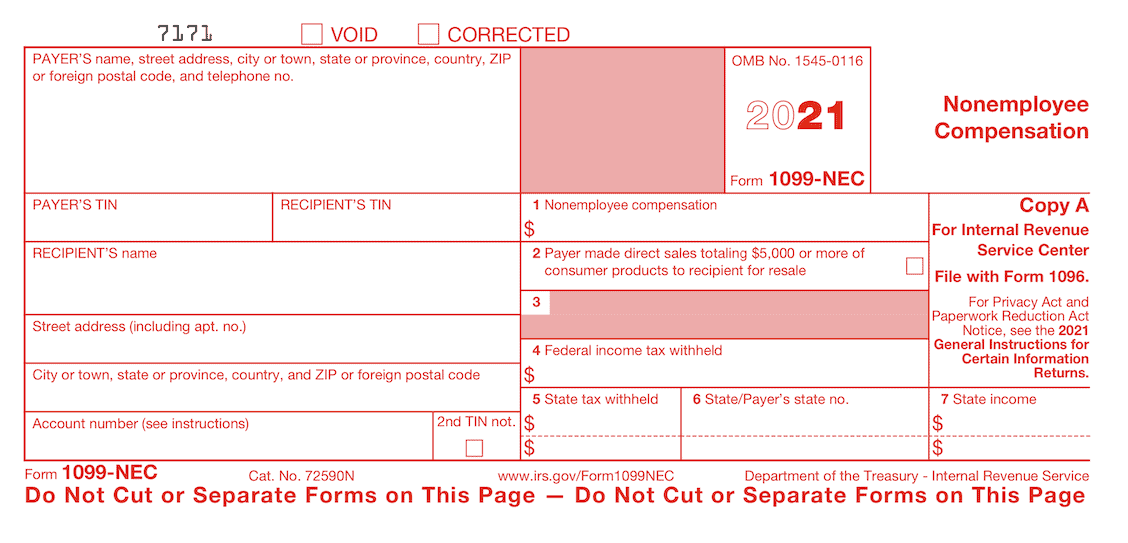
IRS Form 1099-NEC

We can honestly say we didn’t see this one coming. In fact, we thought that the return of Form 1099-NEC was about as likely as, say, a third Bill and Ted movie. Well, we were wrong on both counts. And the funny coincidence is that the return of the 1099-NEC and the release of the third movie (Bill and Ted Face the Music) have both occurred in the same year — 2020, as if this year wasn’t already peculiar enough.

Taking a Closer Look at Form 1099 MISC

Before we look at what changed in 2020 regarding Form 1099-MISC, let’s take a look at what we have all become accustomed to for nearly four decades. Since 1982, businesses that have paid non-employees for their work have issued them a Form 1099-MISC in lieu of a W-2 form (required to report employee compensation).

For the past 38 years, most businesses have been using the 1099-MISC form to report any payments to independent contractors, freelancers, sole-proprietors, and other self-employed individuals who met any of the following three criteria: Continue reading… Continue reading… Continue reading…

How to Protect Yourself Against COVID Scams and Hoaxes

By |2020-04-22T14:47:45-07:00April 22, 2020|Categories: COVID-19|Tags: , , , |0 Comments

Run a Google News search for COVID Scam and you’ll find an endless stream of negative articles. These range from a California doctor busted for selling a bogus “miracle cure,” to a staggering number of stories describing pandemic-related malware and phishing email scams in the past two months.

Then there are news alerts from the Federal Trade Commission, Federal Bureau of Investigation, and U.S. Department of Treasury (among others) telling us to avoid being pulled into these scams and rip-offs. It’s not like we don’t have enough on our plates with this pandemic, now we now have to watch out for criminals determined to scam us out of our money — often when we’re at our most vulnerable.

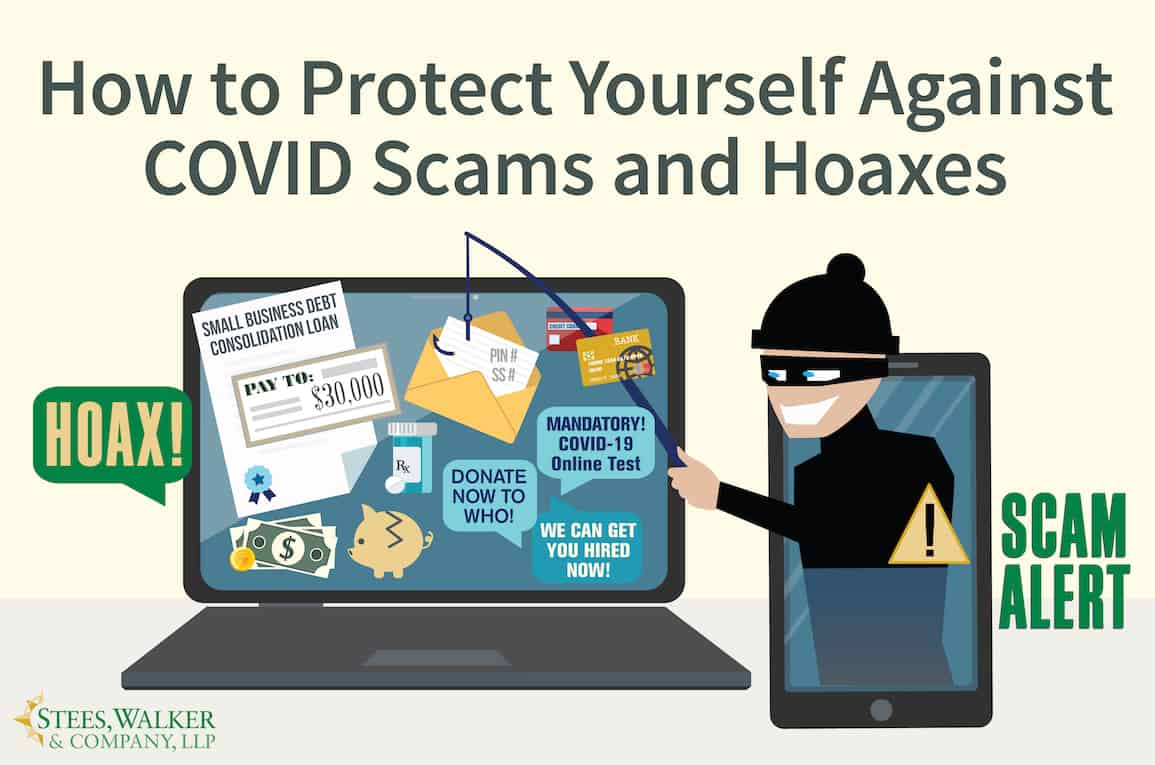
COVID Scam Image

Here at Stees., Walker & Company, LLP we hate to see anyone being suckered by a clever con, so in this post, we offer guidance on how to protect yourself and your money in these difficult times.

Recognizing Common Scams and Hoaxes

One of the best ways to avoid falling victim to a scam or hoax is to recognize how the fraudsters operate. Here are some common scams and hoaxes to beware of:

  • Government imposters: “Con” is short for “confidence,” and what elicits more confidence from people than the belief that they’re dealing with a trusted government representative? Con artists often reach out to people via social media, emails, phone calls, and even knocking on their doors, trying to win their confidence. They present themselves as government agents offering to help, and they use greed or fear to trigger impulsive action. For example, a recent text message claiming to come from the “FCC Financial Care Center” offers $30,000 in COVID-19 relief. Another text message impersonating the U.S. Department of Health and Human Services informs recipients that they must take a “mandatory online COVID-19 test” by clicking a certain link. Whenever someone claims to be from the government threatening punitive action or offers to help, tread very carefully.
  • Scams related to stimulus payments: Taxpayers should be on the lookout for IRS impersonation calls, texts, and email phishing attempts about the COVID-19 Tax Relief and Economic Impact Payments (the so-called stimulus checks). The con artists involved in these scams are looking to steal your stimulus payment or your identity. Take the following precautions: Continue reading… Continue reading… Continue reading…
Go to Top
