

Welcome to Our Blog
We’re a San Diego, Calif.-based boutique tax consulting firm focused on personalized tax and financial guidance to individuals and businesses. Here on our blog, you’ll find you’ll find news, insights, and observations from trusted sources in the world of tax planning and and financial guidance.
California Tax Update: Six 2026 Changes That Could Affect Your Finances
Share This Post

California tax developments can sound deceptively simple when reduced to a headline. A new rebate might look like an automatic savings opportunity. A change in retirement-account taxation might appear relevant only when you file your return. And adding someone to your LLC may seem like a routine ownership change.
In practice, the impact often depends on your individual circumstances and, in some cases, decisions you make before the next tax season arrives. Your residency history, prior tax treatment, family circumstances, business structure, and timing can all change the result. That’s why we continually monitor developments that may affect you, our clients, and consider them within the larger tax planning picture we already understand about each client’s situation.
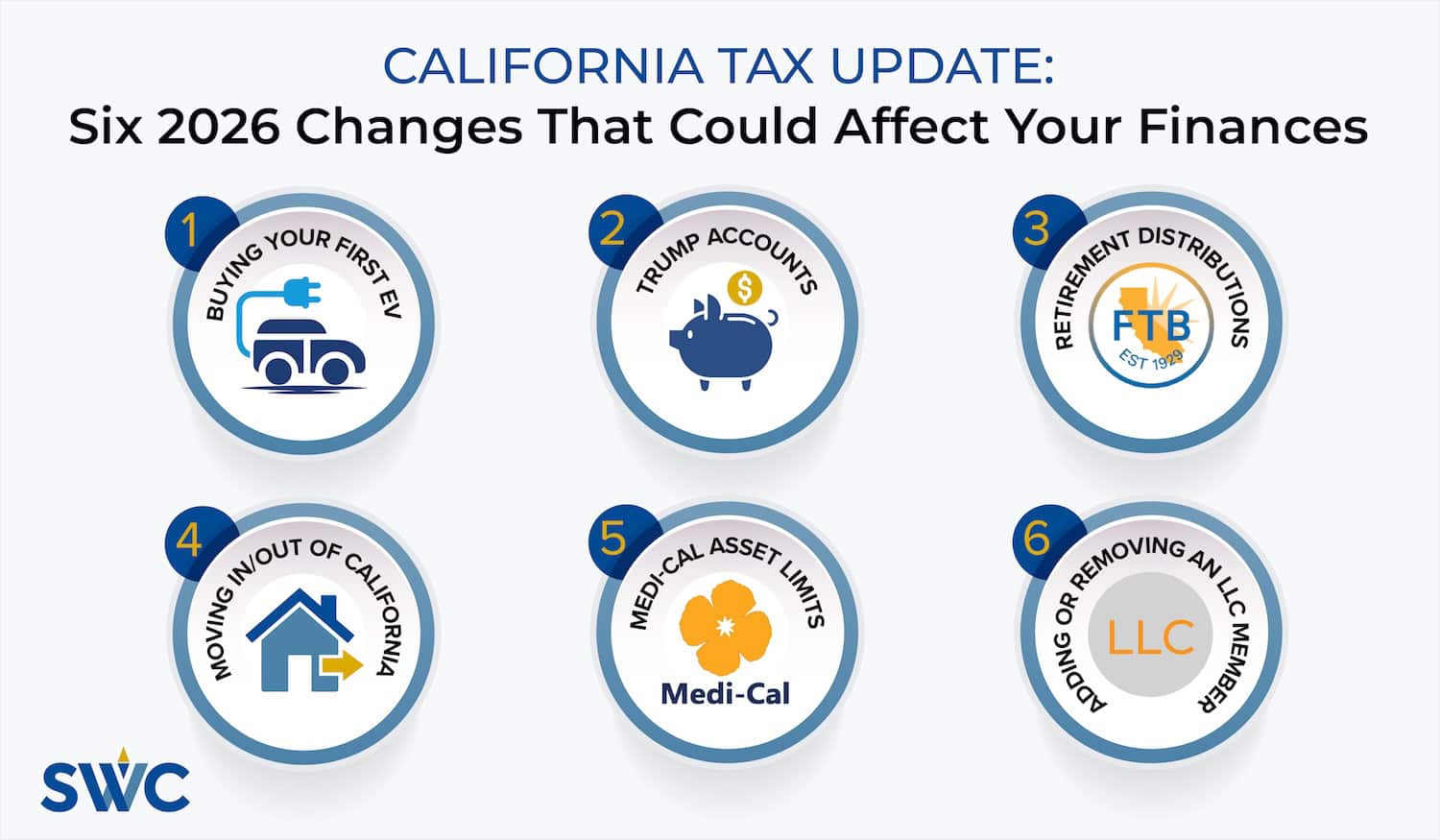
Here are six recent California developments we think deserve attention.
1. Buying Your First EV? California Has a New Rebate Coming
California’s new MyFirstEV program will provide an instant rebate for Californians buying or leasing their first qualifying zero-emission vehicle. The program offers $3,500 toward a qualifying new vehicle with a manufacturer’s suggested retail price of up to $50,000. Certain used vehicles sold for up to $25,000 through manufacturers’ pre-owned programs may qualify for a $1,750 rebate. The program does not impose an income limit on buyers.
The California Air Resources Board (ARB) oversees the program. As of our August 2026 review, California says the rebates will become available this fall, with further information about accessing the program still forthcoming.
That timing could matter if you’re already shopping for an EV. Eligibility also depends on the vehicle and participating manufacturer, so waiting for the final program details may affect your decision.
Thinking about buying or leasing an EV? Talk with us before completing the transaction. We can review the tax considerations in light of your individual circumstances and help you determine how available incentives may affect the economics of your purchase. Contact us: (858) 487-4580 or email admin@swc.cpa.
2. California Has Clarified Its Treatment of Trump Accounts
Trump Accounts are a new federal tax-advantaged account for eligible children. One question for California families has been whether California would follow the federal tax treatment of these accounts. (Read our post “Understanding Trump Accounts: Giving the Next Generation a Financial Head Start” for detailed information about this type of account.)
California has now addressed that uncertainty. Under legislation enacted as part of the state’s <!–more–>2026-27 budget package, The Golden State generally conforms to federal Trump Account taxation beginning with the 2026 tax year. Among the consequences described in the legislation, account earnings receive tax-deferred treatment until distributed, and California recognizes specified exclusions for qualifying employer, governmental, and charitable contributions.
While that makes the California tax treatment clearer, tax treatment represents only one consideration when deciding where to save for a child. Families may have other savings and investment options with different rules governing contributions, distributions, investment choices, and future use of the money.
Considering a Trump Account for your child? Ask us how the account could fit within your family’s existing tax and financial strategy. We can help you evaluate the account based on your family’s circumstances rather than the tax benefit alone.
3. Taking Retirement Distributions? Check Your California Tax Basis
Here’s an issue that can remain hidden for decades. California and federal law have not always treated retirement contributions the same way. As a result, some taxpayers may have a different California tax basis, generally the amount already subjected to California tax, in an IRA or another retirement account than they have for federal purposes.
California’s Franchise Tax Board (FTB) confirms that the taxable amount of a retirement distribution can differ when California and federal deductions differed.
Why does that matter? If California previously taxed money contributed to an account, overlooking that California basis when distributions begin could result in paying California income tax again on money previously taxed by the state.
This issue can arise from older contributions and certain differences between federal and California law. Residency changes can also affect the calculation.
If you’re taking retirement distributions, considering a Roth conversion, or preparing to begin withdrawals, we can review your retirement-account history. Our familiarity with your tax history may help us identify California basis or other tax considerations that could be missed when looking only at the current distribution.
4. Moving Into or Out of California? Timing Matters
California residency can affect far more than the address appearing on your tax return. (We covered this in-depth in Breaking Up Is Hard to Do: Ending Your California Residency.) California residents generally pay state income tax on income regardless of its source, while different sourcing rules apply to nonresidents and part-year residents.
A recent California tax appeal illustrates why the timing of a move and the timing of income can intersect.
In the case Appeal of J. Markham and M. Szpek, the taxpayers Markham and Szpek maintained a home in Washington but moved to California for the husband’s work shortly before receiving retirement distributions. The State of California ultimately treated them as residents when they received the distributions, resulting in more than $10,000 of additional tax plus interest.
Their case also demonstrates the importance of records showing when income was received and facts supporting the taxpayer’s residency position.
Warning: California distinguishes between “residence” and “domicile,” and whether someone’s presence or absence is temporary or transitory depends on the underlying facts.
Planning a move into or out of California around a significant income event? Talk with us before that move or transaction occurs (858-487-4580 or email admin@swc.cpa). We can review the timing within the context of your existing tax picture and identify documentation you may need while the facts are still easy to establish.
5. Medi-Cal Asset Limits Are Scheduled to Change
The State of California has also enacted a significant future change to Medi-Cal eligibility rules for certain residents.
According to the enacted changes covered in our August review, the nonexempt property limit will fall from its current $130,000 level to $21,000 for one person and $31,000 for a two-person household, with an additional amount for larger households. The change will take effect no earlier than July 1, 2027. The affected population can include certain people age 65 or older, people with disabilities, and nursing-home residents.
Medi-Cal eligibility involves rules beyond these asset amounts, so you should avoid treating the new thresholds as a stand-alone eligibility test. The appropriate response will depend on the individual’s circumstances and the rules in effect when eligibility becomes relevant.
If Medi-Cal may become part of planning for you or a family member, let us know. We can review the tax and financial considerations relevant to your circumstances and coordinate with your attorney or other professional advisors when the planning extends beyond our role.
6. Adding or Removing an LLC Member Can Trigger Unexpected Tax Consequences
For California business owners, changing LLC ownership can carry tax consequences that are easy to overlook.
A single-member LLC generally receives different federal tax treatment from an LLC with multiple members taxed as a partnership. California also requires single-member LLCs to file Form 568 (Limited Liability Company Return of Income) and generally subjects California LLCs to an $800 annual tax, with an additional LLC fee potentially applying based on California-source income.
When an LLC moves between single-member and multimember status, the transition can create short tax years and additional California filing and payment obligations. The August 2026 professional guidance we reviewed identifies circumstances in which two short-year California Forms 568, two $800 annual-tax payments, and potentially two LLC fees may result. The exact requirements depend on the LLC’s facts and tax classification.
Thinking about adding a business partner, buying out an existing member, or otherwise changing LLC ownership? Contact us before completing the transaction. Because we understand your business structure and broader tax situation, we can evaluate the tax and filing consequences before the ownership change takes effect.
We’re Here to Help
Each of these six developments involves a different part of tax planning or financial strategy, yet they share an important practical lesson: the headline rarely tells you how the rule applies to you.
If one of these changes touches a decision you’re considering, reach out to us before acting when possible. Understanding your tax history and financial circumstances allows us to move beyond explaining the rule and focus on how it may apply to your situation. Contact us to schedule a consultation: (858) 487-4580 or email admin@swc.cpa.
—————-
Disclaimer: The information in this SWC blog post is provided for general informational purposes only and may not reflect current financial thinking or practices. No information contained in this blog post should be construed as financial advice from the staff at SWC (Stees, Walker & Company, LLP), nor is this the information contained in this blog post intended to be a substitute for financial counsel on any subject matter or intended to take the place of hiring a Certified Public Accountant in your jurisdiction. No reader of this blog post should act or refrain from acting on the basis of any information included in, or accessible through, this blog post without seeking the appropriate financial planning advice on the particular facts and circumstances at issue from a licensed financial professional in the recipient’s state, country or other appropriate licensing jurisdiction.
The Tax Implications of Transferring Property to a Business Entity
Share This Post
When forming a new business or funding an existing business, you may think it’s a good idea to transfer assets to the business entity in exchange for ownership interest (i.e., transferring property to a business entity for shares in the company).
You may also be thinking about transferring certain liabilities (debt) to the entity. Transactions such as these are common, but the way you structure them can have serious tax implications. Sometimes, they trigger immediate taxation. Sometimes, they don’t.
The rules vary dramatically depending on whether you’re dealing with a C corporation, S corporation, partnership, or limited liability company (LLC) taxed as a partnership. The wrong choice, or simply structuring the transaction incorrectly, could leave you with an unexpected tax bill.

In this post, we explain what you need to know before you transfer assets or liabilities to a business entity.
Transferring Property Tax-Free: Tax Rules for Transferring Property to a Business Entity
If you’re wondering whether you can transfer property into a business without immediately recognizing taxable gain, the short answer is yes. But whether a given transaction qualifies for favorable tax treatment depends largely on the type of entity with which you are dealing:
- Corporation (that can be either a C corp. or S corp.)
- Partnership (GP, LP, LLP),
- Limited Liability Company (LLC) taxed as a partnership
Regardless of the type of business entity, the objective is to complete the transfer without triggering immediate taxation.
Transferring Property to a Corporation
If you’re transferring property to a C corp. or S corp., you generally qualify for tax-free treatment only if the people contributing the property collectively own at least 80 percent of the corporation immediately after the transfer. Specifically, the individual or the group contributing the property must collectively own: Continue reading… Continue reading… Continue reading…
What You Should Know About California’s Parent-Child Property Tax Exclusion
Share This Post
Passing a home from one generation to the next often involves more than estate planning. California property tax rules can have a lasting effect on the cost of owning inherited property, and understanding those rules before making a transfer can help your family members and loved ones avoid unexpected tax consequences.

Here at SWC, we closely monitor changes to federal tax law and California property tax rules. Our ongoing attention allows us to incorporate new tax planning opportunities into each client’s personalized tax-saving and wealth-building strategy while helping them make informed financial decisions.
Understanding California’s Parent-Child Property Tax Exclusion
California generally reassesses real property (aka, real estate) to its current market value when ownership changes hands. A higher assessed value often results in higher annual property taxes.
One important exception applies to certain transfers between parents and children. When all of the state’s statutory requirements have been met, the transfer may qualify for an exclusion from reassessment, allowing the child to retain some or all of the parents’ existing taxable value instead of receiving a full reassessment.
Proposition 19 substantially changed these rules for transfers occurring on or after Feb. 16, 2021. Today, the exclusion is more narrowly applied than it was under prior law.
Who Qualifies as a “Child” for California’s Parent-Child Property Tax Exclusion?
For purposes of the parent-child exclusion, California law generally recognizes the following relationships: Continue reading… Continue reading… Continue reading…
Understanding Proposition 19: Property Tax Planning for California Homeowners
Share This Post
California property laws continue to evolve, creating both opportunities and tax planning considerations for homeowners and families alike. Proposition “Prop” 19, for instance, changed the rules governing certain property tax transfers, affecting homeowners who relocate within California as well as families planning to transfer real estate from one generation to the next.
As one of California’s premier tax planning and financial strategy firms, we closely monitor changes to federal tax law and the state’s property tax rules. That ongoing attention allows us to incorporate new planning opportunities into each client’s personalized tax-saving and approach to wealth-building while helping them avoid costly surprises.

In this SWC blog post, we discuss two parts of Prop. 19 that may affect your property taxes:
- Base year value transfers for qualifying homeowners who relocate within California
- Intergenerational transfer exclusions for qualifying family homes or family farms
Understanding California Prop 19
California voters approved Prop 19 on Nov. 3, 2020. Senate Bill 539 later established procedures for its intergenerational exclusions and base-year value transfers, which is just a fancy way of saying a set the rules for property tax transfer and family inheritance provisions.
As a result of the new law, beginning April 1, 2021, qualifying California homeowners could sell their principal residence and transfer its taxable value to a replacement principal residence anywhere in California. A homeowner may also qualify based on age or a severe and permanent disability. Separate rules cover qualifying victims of wildfire or a governor-declared disaster.
Understanding Taxable Value: Taxable value simply means the property’s base year value plus inflationary adjustments. You may also see this amount called the factored base year value.
For example, suppose you’ve owned a home in San Diego for the last 20 years and its taxable value has reached $400,000. Assume the County Assessor determines that the home’s current market value equals $1 million.
If you sell that home and buy another principal residence anywhere in California with an equal or lower market value, you may transfer the $400,000 taxable value to the home you bought. In other words, your property tax would generally begin with the transferred $400,000 taxable value rather than the replacement home’s full market value.
A higher-priced home may also qualify.
Suppose the replacement home has a market value of $1.3 million and you purchase it before selling the original home. The difference in market value equals $300,000: Continue reading… Continue reading… Continue reading…
Summer 2026 Tax Updates Business Owners, Investors & California Taxpayers Should Know
Share This Post
Summer may feel like a quiet time for tax planning, especially after the spring filing rush. In reality, some of the most important tax planning windows open midyear, when business owners, real estate investors, individuals, and families still have time to make informed decisions before the end of the year.
This summer, several federal tax updates deserve attention. Some involve deadlines. Others are focused on Internal Revenue Service (IRS) account access, digital assets, qualified small business stock (QSBS), Health Savings Accounts (HSAs), disaster relief, and Employee Retention Credit claims (refundable tax credits for businesses and non-profits that kept employees on their payroll during pandemic-related government shutdowns or significant revenue declines). And for California taxpayers, the state’s Franchise Tax Board (FTB) identity verification notices deserve a closer look.

In this post, we explain what has changed, who may be affected, and what steps you may need to take before the next tax season catches you by surprise. First up, summer deadlines.
Summer 2026 Tax Deadlines for Individuals and Business Owners
Two July deadlines stand out for taxpayers and business owners.
First, July 6, 2026, marks the deadline for certain Section 174 elections tied to research and experimental expenditures. These rules may matter for businesses with software development, product development, engineering, scientific research, or other innovation-related costs.
Second, July 10, 2026, marks an extended deadline tied to possible COVID-era refund claims for penalties and interest. This deadline stems from litigation involving whether certain filing and payment deadlines received automatic disaster-related postponement during the COVID-19 disaster period (Jan. 20, 2021 – July 10, 2023).
Here’s what that means in plain English: Some taxpayers who paid penalties or interest connected to COVID-era filing or payment timing may have a potential refund claim. The rules remain technical, and the IRS may challenge claims depending on the facts, so it’s best to ask about this during your Summer 2026 Mid-Year Tax Appointment with us here at SWC.
IRS Business Tax Account Access: What Business Owners Should Review in Summer 2026
The IRS has continued to expand online access for business taxpayers. For S corporations and C corporations, certain individuals, known as Designated Officials, can use the IRS Business Tax Account to view information such as Continue reading… Continue reading… Continue reading…
Midyear Tax Planning for Small Businesses: How to Reduce Your 2026 Tax Bill
Share This Post
If you’re like most small-business owners, taxes probably aren’t even a blip on your radar screen right now. After all, you just filed your tax returns on April 15, so why bring up taxes less than two months later?
The reason? Summer is the best time to take a fresh look at your business tax situation. With several months remaining in the year, you have time to make adjustments that could reduce your 2026 tax bill, improve cash flow, reduce tax liabilities, and help you avoid unpleasant surprises next spring. The important thing is to act before year-end. Many of the most effective tax-saving and wealth-building strategies work best when implemented well in advance, not in a last-minute scramble in December.
Last week, we presented forward-looking advice for saving on personal income taxes. This week, we shift our attention to helping small-business owners keep more of their hard-earned profits. The following tax-saving strategies and tactics can help you identify opportunities, evaluate your options, and position your business for a stronger financial finish to 2026.

Maximize Your Qualified Business Income (QBI) Deduction
One of the most valuable tax breaks available to many business owners is the Qualified Business Income (QBI) deduction. It allows many owners of pass-through businesses to deduct up to 20 percent of their business income right off the top. For example, if your business generates $100,000 in qualified business income, you may be able to deduct up to $20,000 and pay federal income tax on the remaining $80,000. Pass-through businesses (income passes through the business to the owners) include:
- Sole proprietorships
- Single-member limited liability companies (LLCs)
- Partnerships
- Multi-member LLCs
- S corporations
Here are a few key details about the QBI deduction: Continue reading… Continue reading… Continue reading…
Get a Jump on Your 2026 Taxes with Mid-Year Tax Planning
Share This Post
With your April 15 tax filing still visible in your rearview mirror, the last thing you probably want to think about is next year’s tax return. After weeks of gathering documents and tracking down deductions, it’s understandable if your thinking has shifted from tax planning to planning your summer vacation.
But summer is one of the best times to take a fresh look at your tax situation. The pressure of filing season is behind you, and you still have plenty of time before year-end deadlines start looming. Small adjustments made now can add up to considerable savings on next year’s tax bill.
A little planning during the summer months can pay dividends leading up to April 15, 2027. Whether you’re hoping to reduce your tax bill or avoid unpleasant surprises next year, we are here to help with your mid-year tax planning. That way, you can fully enjoy your summer, confident that your tax situation is well in hand.
In this post, we share several tax-planning strategies to consider as we head into summer 2026.

Review Your Tax Withholdings or Estimated Tax Payments
Taxes have a way of sneaking up on people. A raise, a side gig, a new deduction, or even a change in family circumstances can throw you off course. The result? An unwelcome surprise come spring. The first order of business is to make sure you’re sending the right amount of money to the taxing authorities throughout the year in the form of tax withholdings and/or estimated tax payments:
- Tax withholdings: Use the IRS Tax Withholding Estimator at to figure out the right amounts to have your employer(s) withhold (and remit) to taxing authorities on your behalf. You’ll need recent pay stubs (for you and your spouse, if you’re married), details of other income, and your most recent tax return (which can be very helpful in helping you gauge whether you’re underpaying or overpaying).
- Estimated tax payments: If you’re self-employed or have additional income from a side job or another source, you should be making quarterly estimated tax payments to both federal and state tax agencies. Start with your expected total annual income, subtract any deductions (or the standard deduction), and estimate your tax based on applicable tax brackets. Then, subtract any withholdings from your day job income. Don’t overlook Social Security income and income from other sources.
Reconsider Standard Versus Itemized Deductions
If you normally claim the standard deduction, consider itemizing. If you normally itemize, consider claiming the standard deduction. For 2026: Continue reading… Continue reading… Continue reading…
Understanding Trump Accounts: Giving the Next Generation a Financial Head Start
Share This Post
One of the many provisions of H.R. 1 (aka, One Big Beautiful Bill Act), which was signed into law by the President in July of last year, is a federally funded stock market indexed investment account for children born between 2025 and 2028.
Funded to the tune of $14.4 billion, these accounts, which are also known as Trump accounts, were recently back in the news, when Michael and Susan Dell announced a pledge to seed millions of these and other accounts with a private contribution of $6.25 billion.
Taken together, children born between ’25 and ’28 will receive $1,000 in their accounts from the federal government, and $250 from the Dells’ contribution. In addition, the Dell pledge accounts for $250 for about 25 million other children born between 2014 and 2024 who live in zip codes where the median household income is $150,000 or less.

The objective of these accounts is to provide every qualifying U.S. child with a financial head start / a starter fund that can grow through investments in public stock markets to finance future life goals when these children become adults. That can include pursuing a college education or specialized training, buying a first home, or even using the funds to start a business.
In this post, we shed light on what Trump accounts are and aren’t, how they work, and what to expect.
According to the Council of Economic Advisers (an agency that resides within the Executive Office of the President), a Trump account started for a baby born in 2026 could grow to more than $300,000 by the time that child turns 18 (assuming maximum contributions and average U.S. stock market returns), and more than $1.9 million by age 28 given the same.
UDATE: The Current Status of Trump Accounts – As of June 24, 2026
As you read this post about Trump Accounts, please note the following:
- Trump Accounts are now in the rollout phase.
- Contributions are scheduled to begin July 4, 2026.
- The U.S. Treasury Department began sending activation emails to authorized individuals in late May 2026.
- Taxpayers who submitted the election can use their IRS online account to monitor status and complete activation steps.
What Trump Accounts Are (and Aren’t)
A Trump Account shares some structural features with an IRA, but it has its own contribution rules, investment restrictions, withdrawal rules, and tax treatment. Think of them as a tax-advantaged complementary savings account for children.
They are not like a 529 plan, which is a tax-advantaged plan specifically for education that often offers tax-free withdrawals when used specifically for qualified educational expenses. Distributions from Trump accounts may be used for purposes other than education, such as buying a first home or starting a business. They’re also not a spending account or a trust fund that can be accessed at any time; early withdrawals are restricted and regulated. Nor are they a substitute for other savings/retirement tools.
How Trump Accounts Work: Eligibility, Contributions, and Distributions
Here’s how Trump accounts work (for more details, please see IRS Notice 2025-68 (PDF)): Continue reading… Continue reading… Continue reading…
Getting Paid to Play College Sports: Compensation and Tax Implications
Share This Post
Student-athletes at American colleges and universities can now get paid for competing in sports (much like professional athletes), and they can earn additional income from the use of their name, image, and likeness (NIL).
An added bonus? They can enjoy all of these perks without suffering penalties for being paid to play. This change in rules has created a fast-growing market that includes brand endorsements, appearances, and income from untraditional sources, including participation in social media-related activities.
As NIL activities expand, businesses, collectives, and schools face important questions about taxes, worker classification, and compliance. The recent Grant House and Sedona Prince v. National Collegiate Athletic Association, et al. court case (aka the NCAA House settlement), which allows schools to pay athletes directly and allocates billions in “back pay,” raises the stakes for any businesses and brands that are involved with NIL deals.
Understanding NIL Collectives: Collectives are groups, usually formed by boosters or supporters of a college, that help student-athletes find and manage opportunities to earn money from their name, image, and likeness. Some collectives act like talent agents and simply connect athletes with companies that want to work with them. Others pay athletes directly for things like appearances or promotional work.
In this post, we explain what NIL is, how student-athletes are classified for tax purposes, the role that collectives play, and how the new rules affect businesses that engage student-athletes.
Giving Athletes the Rights to Their Personal and Professional Assets
The term “NIL rights” refers to a person’s right to control the commercial use of their identity, including their name, photos, likeness, gestures, or appearance. In practice, this means that all college athletes, not just football and basketball players, are allowed to earn money from the following: Continue reading… Continue reading… Continue reading…
8 Year-End Tax-Savings Steps for Business Owners
Share This Post
If you own, operate, or participate in the managements of a business, taxes are always on your mind, especially at the end of every quarter, when estimated payments are due, and the end of the year, when you file your return. As tax year 2025 comes to a close, we at SWC are committed to helping you avoid any surprises while taking full advantage of all the tax breaks your business qualifies for.
Our recent post, “10 Year-End Tax-Savings Tips for 2025 for Individual Filers” revealed ways that any individual taxpayer can trim their tax bill. In this post, we focus our attention on tax-savings strategies specifically for business owners, starting with the often overlooked review of your businesses estimated tax payments.

1. Review Your Estimated Tax Payments
Finding out your business owes thousands, or tens of thousands of dollars, in taxes because it didn’t pay sufficient estimated taxes over the course of the year, and then having to pay a penalty on top of that, is one of the nasty surprises we want to help you avoid. You have one last chance to correct any shortfall. Here are a couple easy ways to calculate the amount of estimated tax you’re likely to owe:
- Use last year’s percentage: If the business earned about the same amount of money this year as you did last year, look at the percentage of its income paid in taxes last year (federal, state, and local), and multiply that percentage by the company’s projected income for this year. For example, if the business earned about $200,000 last year and this year and paid 35 percent in combined income tax and self-employment tax last year, expect to pay about 35 percent this year. For a more accurate estimate, subtract business expenses from gross income before multiplying the percentage.
- Use an online tax estimator: You can find plenty of federal income tax estimators online. However, most are helpful only for estimating the amount of federal income tax you’re likely to owe. The estimate is not likely to include your self-employment tax or state and local taxes. Many calculators are designed only for estimating taxes on employment income, not business income.
After estimating the total income and self-employment tax the business is likely to owe, subtract the amount of estimated tax you have already paid to determine the balances owed to the US Treasury and state and local tax agencies, and then pay those balances by Jan. 15, 2026.
2. Reduce Business Income with Business Expenses
Business expenses are one of the most effective tools for reducing taxable business income because they directly lower net profit (the amount the Internal Revenue Service (IRS) uses to calculate your company’s tax bill). Deductible expenses include the following:
- Office supplies, software, and subscriptions
- Equipment purchases
- Vehicle expenses/mileage
- Utilities, rent, phone, and internet
- Contractor payments
Be sure to take advantage of Section 179 expensing, which enables businesses to immediately deduct the full cost of qualifying equipment and certain improvements in the year they’re placed in service instead of having to depreciate them over the course of several years.
For tax years beginning in 2025, your business can immediately deduct up to $2.5m of qualifying business property placed in service. This covers most equipment, off-the-shelf software, and certain improvements to commercial buildings (known as Qualified Improvement Property, or QIP).
Be aware of the following limitations:
- For purchases made between Jan. 1 and Jan. 19, 2025, the business is only allowed to deduct 40 percent of the cost right away using bonus depreciation. But for anything purchased after Jan. 19, 2025, you can usually deduct 100 percent of the cost in the first year, as long as the asset is placed in service during 2025.
- Section 179 cannot create a business loss.
- The deduction phases out once total qualifying purchases exceed $4 million, disappearing completely at $6.5 million.
- Rules get more complex for partnerships, S corporations, and LLCs taxed as either, so professional guidance from a the pros here at SWC may be needed.
Contact us for details on how the limits work and whether they will affect you or your business entity.
3. Set Up a Retirement Plan for Your Business (If You Haven’t Already)
If you don’t have a retirement plan for your business, you could be missing out on one of the most powerful tax-savings and wealth-building tools available. These plans allow you to make sizable tax-deductible contributions.
Most small businesses use defined contribution plans, such as the following, which are easier to manage than traditional pension plans: Continue reading… Continue reading… Continue reading…