
AB 80: Another Much-Needed Tax Break for California’s Small Businesses

By |2021-05-05T13:32:16-07:00May 5, 2021|Categories: COVID-19|Tags: , , |0 Comments

California business owners received additional tax relief on Friday, April 30, when Governor Gavin Newsom signed Assembly Bill (AB) 80 — a COVID-19 economic recovery package that provides up to $6.8 billion in state tax breaks for California businesses.

Under AB 80, forgiven PPP loans that businesses received from the federal government during the pandemic will not be counted as taxable income, which means businesses that received those loans — and meet certain requirements — can deduct the costs of expenses for those loans. AB 80 also applies to Economic Injury Disaster Loans (EIDL) targeted and advance grants.

According to state officials, the tax breaks will apply to 85 percent of the more than 1 million California businesses that received a combined $97 billion in federal loans. That’s about $96,700 for each business.

Does Your Business Qualify?

To deduct expenses paid with PPP loan forgiven amounts, your business must have Continue reading… Continue reading… Continue reading…

Understanding the American Rescue Plan Act of 2021

On March 11, 2021, the President signed into law the American Rescue Plan Act of 2021 (ARPA) — a $1.9 trillion stimulus package aimed at helping the nation rebound from the economic impact of the COVID-19 pandemic. The Act itself contains more than 600 pages and includes provisions addressing stimulus payments, unemployment benefits, healthcare, state and local funding, along with several tax law changes.

Most of the tax changes are geared toward individual taxpayers, but some affect businesses. In this post, we cover some of the highlights to help you gain a better understanding of the major tax provisions and answer questions you may have.

Getting the Maximum Qualified Stimulus Payment

The big news is the third round of stimulus payments — tax-free money from the federal government. Eligible taxpayers and their qualifying dependents may receive up to $1,400 each. Married couples could receive up to $2,800.

Fewer of us are likely to qualify for the stimulus payment this time around. That’s because the adjusted gross income (AGI) thresholds start at the same amounts, but the phase-out range is much narrower than with prior stimulus payments:

  • $150,000 to $160,000 AGI for joint filers, meaning stimulus payments are gradually reduced for joint filers earning a combined $150,000 AGI or more and are not granted to those earning more than $160,000.
  • $112,500 to $120,000 AGI for head of household.
  • $75,000 to $80,000 AGI for everyone else.

Unlike the prior two stimulus payments, eligible recipients may receive up to $1,400 for all qualifying dependents, including those age 17 and older at year-end.

Tip: The IRS will use the most recently filed tax return to determine these amounts, so do the following to increase your odds of getting a stimulus payment:

  • If your 2020 income decreased (from 2019) and is below or within one of the ranges above, file your 2020 return as soon as possible, so that your lower 2020 income will be used to determine whether you get a stimulus payment and how much it will be.
  • If your 2020 income increased (from 2019) to a point that disqualifies you from receiving a stimulus check or reduces the amount, consider waiting to file your 2020 tax return until you receive your stimulus payment.

Taking Advantage of the Extension to Unemployment Insurance

The American Rescue Plan Act of 2021 extends federal supplemental unemployment benefits that were set to expire on March 14, 2021. The new law extends the period eligible individuals may receive an additional Continue reading… Continue reading… Continue reading…
Maximizing Your PPP Benefits and Employer Tax Credits

In 2020, Congress passed a flurry of COVID-19 related legislation designed to help employers retain and pay their employees and stay in business. This relief has been offered primarily in two forms:

  • Paycheck Protection Program (PPP): PPP loans have been made available to qualifying small businesses to help them stay afloat and retain and pay as many of their employees as possible. A business receiving a PPP loan can then apply to have the loan forgiven; that is, whatever portion of the loan was used for qualifying payroll and expenses.
  • Employer tax credits: Additional employer tax credits have been made available to help employers cover the cost of sick and family leave for employees, employees who need to care for someone with coronavirus (including a child whose school or daycare is closed due to the coronavirus), and retaining employees when operations have been partially or fully suspended due to government orders during the pandemic.

Understanding and taking full advantage of these benefits within the parameters stipulated in the legislation can be challenging for small-business owners. At SWC, we’re here to help.

In this post, we provide an overview of the COVID-19 pandemic relief programs for which your business may be eligible. When preparing your business tax returns this year, your accountant or CPA should be asking you for copies of payroll tax returns and should be initiating additional consultations with you to see if you are eligible for any of the new employer tax credits. We say should because that’s how we handle this at SWC.

Wait! Before You File Your 2020 Tax Return, Read This

Don’t rush to file your 2020 tax returns. Consult with us first for three important reasons:

  1. Both the PPP and the new employer tax credits provide potentially significant benefits for your business, and we want to make sure you reap the maximum benefit.
  2. The new employer tax credits cannot be claimed on the same payroll being used for the PPP loan forgiveness. When completing your tax return and submitting documents for PPP loan forgiveness, you need to be sure you’re not confusing the two benefits.
  3. Your state may not follow all the federal guidelines. We can help ensure that your state taxes account for any differences.

If you feel pressured to file your 2020 tax returns and are uncertain about any of the details related to the PPP or new employer tax credits, we strongly encourage you to file for an extension. With that recommendation in mind, it’s important that you take the time to consult with your tax advisor.

Sorting Out PPP Rounds 1 and 2

Congress provided two rounds of PPP loans — one in the spring of 2020 and another near the end of 2020. If you have taken advantage of the PPP, you should understand the rules and the differences between the two rounds (or “draws.”)

Important: The Coronavirus Aid, Relief and Economic Security (CARES) Act, enacted in March 2020, was silent on whether expenses paid with the proceeds of first draw PPP loans could be deducted. The IRS took the position that these expenses were nondeductible. However, the Consolidated Appropriations Act, 2021 (CAA, 2021), enacted at the end of 2020, provides that expenses paid from the proceeds of both first and second draw PPP loans are Continue reading… Continue reading… Continue reading…
The Potential Tax Implications of COVID-19 Legislation

By |2021-02-26T14:11:03-08:00February 10, 2021|Categories: COVID-19|0 Comments

The dark clouds of the coronavirus pandemic continue to hang heavy over all of us, but even these clouds have a silver lining. The Consolidated Appropriations Act (CAA), signed into law on Dec. 27, 2020, provides for a second round of stimulus payments ($600 per taxpayer and qualifying child), an expansion of the Paycheck Protection Program (PPP), and numerous tax provisions and extensions that benefit both individuals and businesses.

The 2021 tax year brings additional relief in the form of increased contribution limits to retirement accounts, an increase in the standard deduction, and increases in other tax-related limitations and thresholds. (Under our country’s tax code, the standard deduction is a dollar amount that non-itemizers may subtract from their income before income tax is applied.)

In this post, we highlight recent tax provisions, extensions, limits and thresholds you should be aware of as you prepare your 2020 taxes and plan for the coming 2021 tax year.

CAA Provisions for Individuals, Payroll, and Businesses

Consolidated Appropriations Act (CAA) provisions apply to individuals, payroll, and businesses, as presented in the following sections.

Provisions for Individual Taxpayers

The CAA offers the following benefits for individual taxpayers: Continue reading… Continue reading… Continue reading…
Update on How to Have Your Paycheck Protection Program Loan Forgiven

By |2020-05-29T11:22:27-07:00May 28, 2020|Categories: COVID-19|Tags: , |0 Comments

If you read our April 29 post, “How to Determine Loan Forgiveness Under the Paycheck Protection Program,” or if you’re an owner or manager of one of the nearly 4 million U.S. businesses that received a loan under the Paycheck Protection Program (PPP) — you’re probably starting to wonder how to go about having that loan converted to a grant and forgiven.

SBA Paycheck Protection Program Loan Forgiveness   Application

For the uninitiated, the PPP is a $659-billion economic relief program established as part of the Coronavirus Aid, Relief, and Economic Security (CARES) Act to help small businesses, self-employed workers, sole proprietors, certain nonprofit organizations, and tribal businesses remain solvent and continue paying their workers during the COVID-19 shutdown. Under the PPP, a qualifying small business (generally with fewer than 500 employees) could obtain a loan of up to $10 million at a very low interest rate (1%) and have the loan forgiven after proving that the money was used for qualified payroll and other expenses.

Earlier this month, the Small Business Administration (SBA)released its PPP Loan Forgiveness Application along with detailed instructions for completing and submitting the application.

The form’s instructions help you understand how to apply for forgiveness of your PPP loan, consistent with the CARES Act. and to simplify the process, the instructions and form include several measures to reduce compliance burdens, including: Continue reading… Continue reading… Continue reading…
How to Determine Loan Forgiveness Under the Paycheck Protection Program

By |2020-04-29T15:08:05-07:00April 29, 2020|Categories: COVID-19|Tags: , |1 Comment

The recent $669-billion Paycheck Protection Program (PPP) established by the Coronavirus Aid Relief and Economic Security (CARES) Act has been enacted to a chorus of mixed reviews.

The PPP provides loans of up to $10 million per eligible small business to cover payroll costs and other qualifying expenses (such as rent and utilities) to keep small businesses afloat and employees paid until government agencies allow them to reopen. Perhaps best of all, the total amount of each loan used to cover payroll and qualifying expenses may ultimately be forgiven. In other words, the U.S. government won’t require repayment under certain conditions.

Since banks started taking applications for PPP loans, the program has been plagued with controversy — from big businesses getting the lion’s share of the allocated funds to employers having to contend with furloughed and laid off employees who do not see the value in returning to work because they may be able to earn more by remaining on unemployment.

Paycheck Protection Program Forgiveness  Loan Calculations

If your company applied for and was approved for a PPP loan, all of this controversy may be water under the bridge. Now your concern is focused on how much of the money you received in the form of a PPP loan will need to be paid back. This post addresses that concern — both for businesses with employees and for self-employed individuals.

Loan Forgiveness for Businesses with Employees

If you own a business and have employees working for you, the amount of your Paycheck Protection Program loan that will be forgiven is said to be equal to the following payments made, and the costs incurred during the eight-week period beginning on the loan origination date (the first disbursement date):

  • Payroll costs:
    • Gross salary, wages, commissions, or tips paid to employees (based on an annual wage of up to $100,000 per worker)
    • Vacation, parental, family, medical, or sick leave (excluding any family or sick leave covered under the Families First Coronavirus Response Act and reimbursed through payroll tax credits)
    • Termination allowances
    • Group health care benefits, including insurance premiums
    • Retirement benefit payments
    • State and local payroll taxes
  • Mortgage interest on a mortgage taken out by the borrower for real or personal property incurred prior to Feb. 15, 2020 (not including prepayments)
  • Rent on a lease taken out before Feb. 15, 2020
  • Utilities for service begun before Feb. 15, 2020

The entire amount of the Paycheck Protection Program loan is supposed to be forgiven if you meet all three of the following conditions: Continue reading… Continue reading… Continue reading…

How to Protect Yourself Against COVID Scams and Hoaxes

By |2020-04-22T14:47:45-07:00April 22, 2020|Categories: COVID-19|Tags: , , , |0 Comments

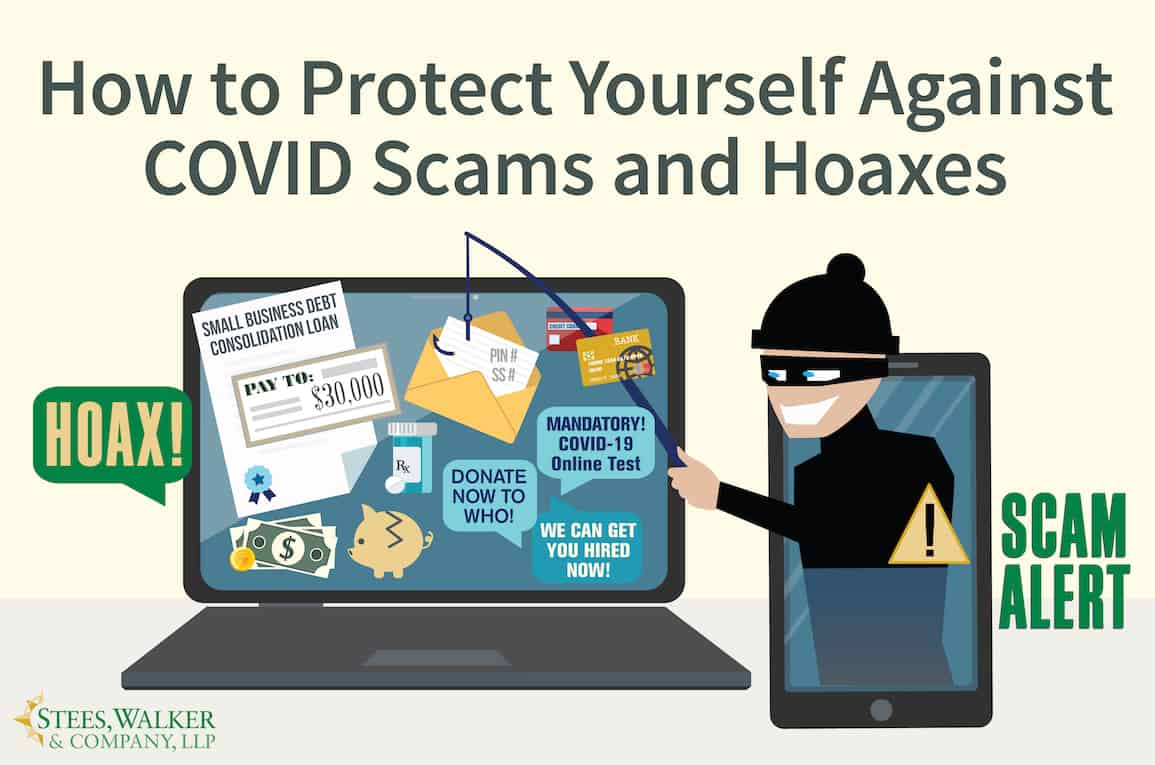
Run a Google News search for COVID Scam and you’ll find an endless stream of negative articles. These range from a California doctor busted for selling a bogus “miracle cure,” to a staggering number of stories describing pandemic-related malware and phishing email scams in the past two months.

Then there are news alerts from the Federal Trade Commission, Federal Bureau of Investigation, and U.S. Department of Treasury (among others) telling us to avoid being pulled into these scams and rip-offs. It’s not like we don’t have enough on our plates with this pandemic, now we now have to watch out for criminals determined to scam us out of our money — often when we’re at our most vulnerable.

COVID Scam Image

Here at Stees., Walker & Company, LLP we hate to see anyone being suckered by a clever con, so in this post, we offer guidance on how to protect yourself and your money in these difficult times.

Recognizing Common Scams and Hoaxes

One of the best ways to avoid falling victim to a scam or hoax is to recognize how the fraudsters operate. Here are some common scams and hoaxes to beware of:

  • Government imposters: “Con” is short for “confidence,” and what elicits more confidence from people than the belief that they’re dealing with a trusted government representative? Con artists often reach out to people via social media, emails, phone calls, and even knocking on their doors, trying to win their confidence. They present themselves as government agents offering to help, and they use greed or fear to trigger impulsive action. For example, a recent text message claiming to come from the “FCC Financial Care Center” offers $30,000 in COVID-19 relief. Another text message impersonating the U.S. Department of Health and Human Services informs recipients that they must take a “mandatory online COVID-19 test” by clicking a certain link. Whenever someone claims to be from the government threatening punitive action or offers to help, tread very carefully.
  • Scams related to stimulus payments: Taxpayers should be on the lookout for IRS impersonation calls, texts, and email phishing attempts about the COVID-19 Tax Relief and Economic Impact Payments (the so-called stimulus checks). The con artists involved in these scams are looking to steal your stimulus payment or your identity. Take the following precautions: Continue reading… Continue reading… Continue reading…

Estimating Your Paycheck Protection Program Loan Amount

By |2020-04-10T18:05:58-07:00April 10, 2020|Categories: COVID-19|Tags: , |0 Comments

If you’re a small-business owner, sole-proprietor, freelancer, or independent contractor, you may be wondering just how much money you are eligible to borrow under the Paycheck Protection Program (PPP).

For those unfamiliar with the Paycheck Protection Program, it is part of the Coronavirus Aid, Relief, and Economic Security (CARES) Act, which was signed into law on Friday, March 27, 2020. As of April 3, businesses with fewer than 500 employees, and other entities that qualify as small businesses, are eligible for loans of up to $10 million to keep them afloat and their workers paid for up to eight (8) weeks, without having to pay back the portion of the loan used to cover payroll and other qualified costs — mortgage interest (or rent) and utilities.

Paycheck Protection Program Loan Amount

The short answer to how much money your business may be eligible to borrow under the Paycheck Protection Program is this:

  • You can borrow up to 2.5 times your monthly payroll costs or up to $10 million, whichever is less; however,
  • When you apply for a PPP loan, the bank will want a more precise estimate of your payroll costs and other qualified costs.

In this post, we provide some general guidance on estimating your Paycheck Protection Program loan amount based on our interpretation of law. Your bank (or your accountant if you’re not a client of our San Diego Tax Planning Firm) can help you determine the exact amount based on your bank’s interpretation of the law.

Calculate the Maximum Amount You Can Borrow

The Small Business Administration provides the following step-by-step instructions for calculating the maximum amount you can borrow under the Paycheck Protection Program: Continue reading… Continue reading… Continue reading…

Answers to Paycheck Protection Program Questions

By |2020-04-08T17:37:43-07:00April 8, 2020|Categories: COVID-19|Tags: , |0 Comments

Since the Payroll Protection Program (PPP) launched on Friday, April 3, 2020, small-business owners have been hard-pressed to find banks that will accept PPP loan applications. Many banks and small-business owners say they are struggling to understand Small Business Administration (SBA) and U.S. Department of Treasury PPP-related rules and regulations.

In addition to puzzling over these mandates that govern the distribution of funds, banks find themselves scrambling to get personnel and processes in place to properly handle the application and approval process.

Here at Stees, Walker & Company LLP, we are encouraging small-business owners who are waiting for banks to get up to speed on the Payroll Protection Program to make preparations in advance. See last week’s post, “Get Ready for the Paycheck Protection Program NOW!

For the uninitiated, the Payroll Protection Program was established as part of the Coronavirus Aid, Relief, and Economic Security (CARES) Act, which was signed into law on Friday, March 27, 2020. The PPP has allotted $349 billion to provide small businesses with low-interest loans of up to $10 million per loan to keep them afloat and their workers paid for up to eight (8) weeks.

Sole proprietors, freelancers, and self-employed individuals are also eligible. To qualify, applicants need not put up any collateral or make any personal guarantee of repayment Payments are deferred for up to six months and, most importantly, the portion of the loan proceeds used to cover payroll and qualified operating expenses (which can be up to about 25 percent of the total loan amount) are likely to be forgiven.

Part of the reason for the delay among banks and small-business owners is confusion over the rules and the process. To clarify the rules, on April 7, 2020, the Small Business Administration (SBA) issued clarifications, many of which address how small businesses should determine their payroll costs. Following is a condensed version these clarifications: Continue reading… Continue reading… Continue reading…

Go to Top