
How to Protect Yourself Against 2022 Tax and Unemployment Scams

It’s tax filing season — prime time for scum of the earth con artists to crawl out from under their rocks with novel ways to steal identities and scam people out of their hard-earned money.

That means it’s time for us, as one of Southern California’s premier women-owned tax planning and financial strategy firms, to let you know what to watch out for and how to protect yourself. By remaining vigilant and reporting suspicious activity to relevant government agencies and law enforcement, we can start gaining the upper hand over these criminals.
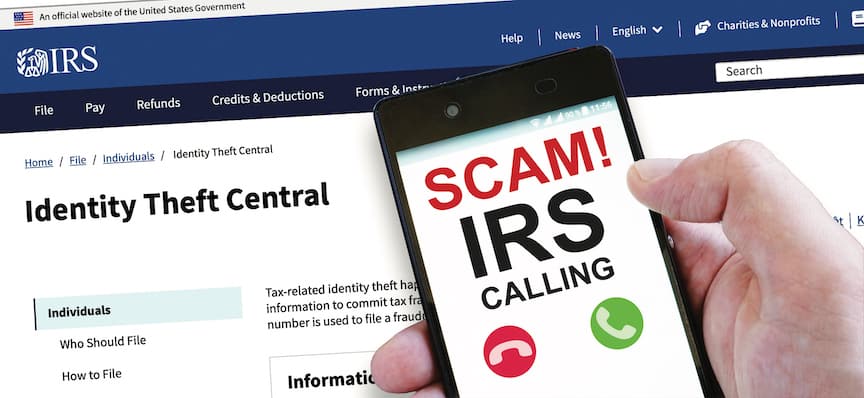
IRS scam graphic

In this post, we call your attention to four primary methods used to steal identities and tax refunds. We’ll also reveal common warning signs and offer guidance on what to do when you notice suspicious activity.

Text Message Scams

Text message scams usually involve someone pretending to be from the Internal Revenue Service (IRS). Over the last couple of years, fraudulent text messages have focused mostly on COVID-19 or “stimulus payments,” and included one or more links claiming to point to IRS websites or relevant online tools.

If you receive an unsolicited text/SMS message that appears to be from either the IRS or a program closely linked to it, take a screenshot of the text message and email it to phishing@irs.gov with the following information: Continue reading… Continue reading… Continue reading…


2022 Tax and Employer Rules and Regulations

If you own or operate a business, you’re no stranger to payroll taxes — the money you withhold from an employee’s pay to remit to government tax collectors on the employee’s behalf. You pay a portion of these taxes, and your employees pay a portion. The money collected is allocated to the following:

  • Federal Insurance Contributions Act (FICA) to fund Old Age, Survivors, and Disability Insurance (OASDI), also known as Social Security and Disability, and Medicare (health insurance for senior citizens and the disabled)
  • State Disability Insurance (SDI)
  • Federal Unemployment Insurance (FUI)
  • State Unemployment Insurance (SUI)
  • Employment Training Tax (ETT)

In today’s post, we’ll bring you up to speed on what you need to know to plan for, pay, and remain in compliance with these and other withholdings for 2022. We’ll also share information about important changes and reminders that your business needs to be aware of for the year ahead. First up, Social Security.

Social Security Tax

For 2022, the Social Security tax rate is 6.2 percent for employer and employee — unchanged from 2021. The Social Security wage base has increased from $142,800 in 2021 to $147,000 in 2022. In other words, Social Security tax applies only to the first $147,000 an employee earns, so the maximum you would withhold on behalf of the employee is $9,114.

Keep in mind that the employee’s share is only half of the total Social Security tax owed. As an employer, you are responsible for paying the other half. So, if you deduct and remit $9,114 on behalf of your employee, you are required to pay an additional $9,114 as employer.

Self-employed individuals are required to pay both “halves,” so a self-employed individual with a net income of $147,000 would pay $9,114 x 2 = $18,228 in Social Security Tax. To take some of the sting out of paying both halves of FICA, self-employed individuals receive a deduction for self-employment tax on their federal income tax return.

Medicare Tax

The Medicare tax rate is Continue reading… Continue reading… Continue reading…

The Infrastructure Investment and Jobs Act: What Taxpayers Need to Know

Lawmakers in Washington, D.C., are interested in many things, including opportunities for creating generation-defining legislation. So it was in November that Congress passed a bipartisan infrastructure deal with implications that included changing the end date of the Employee Retention Credit and establishing reporting requirements for cryptocurrency transactions.

The Infrastructure Investment and Jobs Act (H.R. 3684), which was signed into law on the Nov. 15 by President Biden, was originally introduced in the U.S. House of Representatives as the INVEST in America Act. It began as a $715-billion infrastructure bill to address provisions related to federal-aid highway, transit, highway safety, motor carrier, research, hazardous materials, and rail programs of the Department of Transportation (DOT).

Infrastructure Legislation Image

During congressional negotiations, it was expanded to include funding for broadband access, clean water, and electric grid renewal. The revised version, renamed the Infrastructure Investment and Jobs Act, calls for approximately $1.2 trillion in spending.

In this post, we cover several new tax provisions in H.R. 3684 that may impact you as an individual taxpayer, contractor, or business owner.

New Tax Provisions for Individuals

As a result of the passage of H.R. 3684, the following tax provisions now apply to individual taxpayers: Continue reading… Continue reading… Continue reading…

Go to Top
