
Deferring Taxes on Real Estate Sales with a Like-Kind / 1031 Exchange
Share This Post

If you’re thinking about selling an investment property, the first question you should ask before anything else: How much of my profit will go to taxes?
For real estate investors, entrepreneurs, and high-net-worth individuals like the ones we work with here at SWC, the answer to that questions can be “tons!” That is, unless you know how to work the system. A like-kind exchange — also known as a 1031 exchange — enables you to sell one investment property and reinvest the proceeds into another, all while deferring capital gains taxes. It’s a savvy move, but only if you follow the rules.
In this post, we provide a clear breakdown of how like-kind exchanges work, what rules you need to follow, and how to make the most of this powerful tax-deferral strategy.
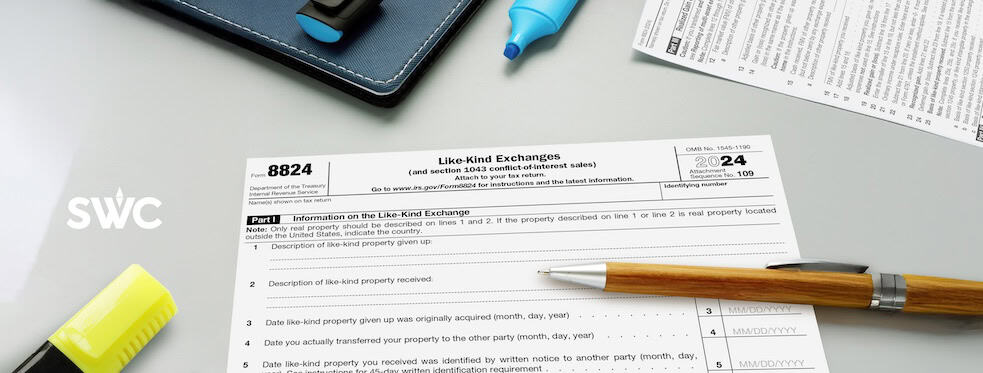
Here’s what you need to know.
Understanding the 1031 Exchange
A 1031, also known as a like-kind exchange, involves exchanging real estate used solely for business or held as an investment for other business or investment property that is the same type. For example, you may sell a rental property and buy a different rental property.
Generally, when you make a like-kind exchange, you’re not required to recognize a gain or loss under Internal Revenue Code Section 1031 (there’s where the moniker “1031 exchange” comes from.) However, if as part of the exchange, you also receive other (not like-kind) property or money, you must recognize that gain to the extent of the other property and/or money received. Under no circumstances can you recognize a loss.
Deploying a1031 exchange is a powerful strategy for real estate investors to postpone paying capital gains taxes on the sale of their investment properties. By selling one investment property and reinvesting the proceeds in another investment property of equal or greater value, you can defer capital gains and depreciation-recapture taxes. Better yet, by continuing to defer capital gains through successive like-kind exchanges, you may eventually qualify for a basis step-up, which can effectively eliminate the deferred taxes altogether!
Basis Step-Up? A basis step-up is an adjustment of the cost basis of an asset to its fair market value at the time of an owner’s death. If the cost basis of the investment property is equal to or greater than that for which the property ultimately sells, the profit from the sale is zero or negative, meaning no capital gains tax is owed.
A Sample Transaction
Capital gains taxes can be as high as 42.1 percent depending on your income, filing status, and state. If you’re a client of ours, we can provide a precise estimate. If you’re not one of our clients, we encourage you to consult your CPA to obtain an estimate based specifically on your unique situation. Before selling an investment property or a property you use exclusively for business purposes, you should always know how much you stand to lose in taxes.
Let’s look at how much money a like-kind / 1031 exchange could allow you to defer in taxes for the sale of a $1.5 million investment property in California: Continue reading… Continue reading… Continue reading…
