
How to Determine Loan Forgiveness Under the Paycheck Protection Program

By |2020-04-29T15:08:05-07:00April 29, 2020|Categories: COVID-19|Tags: , |1 Comment

The recent $669-billion Paycheck Protection Program (PPP) established by the Coronavirus Aid Relief and Economic Security (CARES) Act has been enacted to a chorus of mixed reviews.

The PPP provides loans of up to $10 million per eligible small business to cover payroll costs and other qualifying expenses (such as rent and utilities) to keep small businesses afloat and employees paid until government agencies allow them to reopen. Perhaps best of all, the total amount of each loan used to cover payroll and qualifying expenses may ultimately be forgiven. In other words, the U.S. government won’t require repayment under certain conditions.

Since banks started taking applications for PPP loans, the program has been plagued with controversy — from big businesses getting the lion’s share of the allocated funds to employers having to contend with furloughed and laid off employees who do not see the value in returning to work because they may be able to earn more by remaining on unemployment.

Paycheck Protection Program Forgiveness  Loan Calculations

If your company applied for and was approved for a PPP loan, all of this controversy may be water under the bridge. Now your concern is focused on how much of the money you received in the form of a PPP loan will need to be paid back. This post addresses that concern — both for businesses with employees and for self-employed individuals.

Loan Forgiveness for Businesses with Employees

If you own a business and have employees working for you, the amount of your Paycheck Protection Program loan that will be forgiven is said to be equal to the following payments made, and the costs incurred during the eight-week period beginning on the loan origination date (the first disbursement date):

  • Payroll costs:
    • Gross salary, wages, commissions, or tips paid to employees (based on an annual wage of up to $100,000 per worker)
    • Vacation, parental, family, medical, or sick leave (excluding any family or sick leave covered under the Families First Coronavirus Response Act and reimbursed through payroll tax credits)
    • Termination allowances
    • Group health care benefits, including insurance premiums
    • Retirement benefit payments
    • State and local payroll taxes
  • Mortgage interest on a mortgage taken out by the borrower for real or personal property incurred prior to Feb. 15, 2020 (not including prepayments)
  • Rent on a lease taken out before Feb. 15, 2020
  • Utilities for service begun before Feb. 15, 2020

The entire amount of the Paycheck Protection Program loan is supposed to be forgiven if you meet all three of the following conditions: Continue reading… Continue reading… Continue reading…
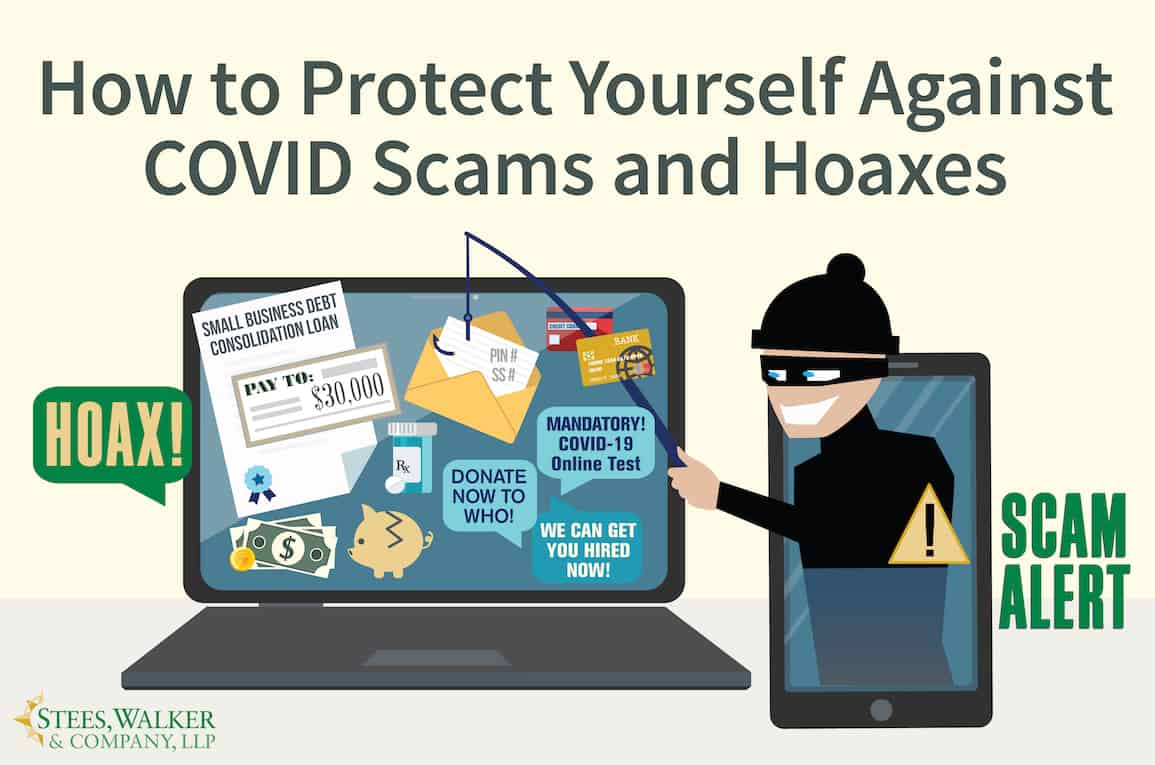
How to Protect Yourself Against COVID Scams and Hoaxes

By |2020-04-22T14:47:45-07:00April 22, 2020|Categories: COVID-19|Tags: , , , |0 Comments

Run a Google News search for COVID Scam and you’ll find an endless stream of negative articles. These range from a California doctor busted for selling a bogus “miracle cure,” to a staggering number of stories describing pandemic-related malware and phishing email scams in the past two months.

Then there are news alerts from the Federal Trade Commission, Federal Bureau of Investigation, and U.S. Department of Treasury (among others) telling us to avoid being pulled into these scams and rip-offs. It’s not like we don’t have enough on our plates with this pandemic, now we now have to watch out for criminals determined to scam us out of our money — often when we’re at our most vulnerable.

COVID Scam Image

Here at Stees., Walker & Company, LLP we hate to see anyone being suckered by a clever con, so in this post, we offer guidance on how to protect yourself and your money in these difficult times.

Recognizing Common Scams and Hoaxes

One of the best ways to avoid falling victim to a scam or hoax is to recognize how the fraudsters operate. Here are some common scams and hoaxes to beware of:

  • Government imposters: “Con” is short for “confidence,” and what elicits more confidence from people than the belief that they’re dealing with a trusted government representative? Con artists often reach out to people via social media, emails, phone calls, and even knocking on their doors, trying to win their confidence. They present themselves as government agents offering to help, and they use greed or fear to trigger impulsive action. For example, a recent text message claiming to come from the “FCC Financial Care Center” offers $30,000 in COVID-19 relief. Another text message impersonating the U.S. Department of Health and Human Services informs recipients that they must take a “mandatory online COVID-19 test” by clicking a certain link. Whenever someone claims to be from the government threatening punitive action or offers to help, tread very carefully.
  • Scams related to stimulus payments: Taxpayers should be on the lookout for IRS impersonation calls, texts, and email phishing attempts about the COVID-19 Tax Relief and Economic Impact Payments (the so-called stimulus checks). The con artists involved in these scams are looking to steal your stimulus payment or your identity. Take the following precautions: Continue reading… Continue reading… Continue reading…

Understanding Small-Business Tax Deductions

As part of an effort to mitigate the effects of the spread of the coronavirus known as COVID-19, the Internal Revenue Services has chosen to delay the April 15, 2020 tax filing deadline for most individual taxpayers and businesses to July 15, 2020. Regardless of the deadline, one thing that isn’t expected to change anytime soon is what a business can and cannot claim as a tax deduction. And in today’s post, we offer insight into exactly that — what small businesses can and cannot deduct, regardless of the tax filing deadline.

A deduction (or write-off) is an expense or portion of an expense subtracted from your company’s gross income that reduces the income on which taxes are calculated. Every dollar you claim as a deduction is a dollar less that is subject to federal, state, and local income tax and self-employment tax (Social Security and Medicare).

Small Business Deductions Image

For example, if your effective federal income tax rate is 25 percent, and you pay 15.3 percent in self-employment tax and 5 percent in state and local income tax, every thousand dollars less you report in taxable income is over 450 dollars you save in taxes: (0.25 + 0.153 + 0.05) x $1,000 = 0.453 x $1,000 = $453.

The Tax Cuts and Jobs Act (TCJA), which became effective in 2018, made it less advantageous for taxpayers to itemize personal deductions. However, if you own a small business — such as a sole-proprietorship, limited liability company (LLC), or partnership — you can deduct a broad range of business expenses to lower the taxable income you earn from that business.

Here are a couple tips for claiming business deductions without getting into legal trouble:

  • Seek confirmation from a tax specialist or certified public accountant (CPA) before claiming any business expense as a deduction.
  • Keep accurate, detailed records, including invoices and receipts for all business expenses. (Your CPA can help you find accounting packages and apps to simplify your record-keeping.)

In the following sections, we present a long list of common small-business tax deductions. Continue reading… Continue reading… Continue reading…

Estimating Your Paycheck Protection Program Loan Amount

By |2020-04-10T18:05:58-07:00April 10, 2020|Categories: COVID-19|Tags: , |0 Comments

If you’re a small-business owner, sole-proprietor, freelancer, or independent contractor, you may be wondering just how much money you are eligible to borrow under the Paycheck Protection Program (PPP).

For those unfamiliar with the Paycheck Protection Program, it is part of the Coronavirus Aid, Relief, and Economic Security (CARES) Act, which was signed into law on Friday, March 27, 2020. As of April 3, businesses with fewer than 500 employees, and other entities that qualify as small businesses, are eligible for loans of up to $10 million to keep them afloat and their workers paid for up to eight (8) weeks, without having to pay back the portion of the loan used to cover payroll and other qualified costs — mortgage interest (or rent) and utilities.

Paycheck Protection Program Loan Amount

The short answer to how much money your business may be eligible to borrow under the Paycheck Protection Program is this:

  • You can borrow up to 2.5 times your monthly payroll costs or up to $10 million, whichever is less; however,
  • When you apply for a PPP loan, the bank will want a more precise estimate of your payroll costs and other qualified costs.

In this post, we provide some general guidance on estimating your Paycheck Protection Program loan amount based on our interpretation of law. Your bank (or your accountant if you’re not a client of our San Diego Tax Planning Firm) can help you determine the exact amount based on your bank’s interpretation of the law.

Calculate the Maximum Amount You Can Borrow

The Small Business Administration provides the following step-by-step instructions for calculating the maximum amount you can borrow under the Paycheck Protection Program: Continue reading… Continue reading… Continue reading…

Answers to Paycheck Protection Program Questions

By |2020-04-08T17:37:43-07:00April 8, 2020|Categories: COVID-19|Tags: , |0 Comments

Since the Payroll Protection Program (PPP) launched on Friday, April 3, 2020, small-business owners have been hard-pressed to find banks that will accept PPP loan applications. Many banks and small-business owners say they are struggling to understand Small Business Administration (SBA) and U.S. Department of Treasury PPP-related rules and regulations.

In addition to puzzling over these mandates that govern the distribution of funds, banks find themselves scrambling to get personnel and processes in place to properly handle the application and approval process.

Here at Stees, Walker & Company LLP, we are encouraging small-business owners who are waiting for banks to get up to speed on the Payroll Protection Program to make preparations in advance. See last week’s post, “Get Ready for the Paycheck Protection Program NOW!

For the uninitiated, the Payroll Protection Program was established as part of the Coronavirus Aid, Relief, and Economic Security (CARES) Act, which was signed into law on Friday, March 27, 2020. The PPP has allotted $349 billion to provide small businesses with low-interest loans of up to $10 million per loan to keep them afloat and their workers paid for up to eight (8) weeks.

Sole proprietors, freelancers, and self-employed individuals are also eligible. To qualify, applicants need not put up any collateral or make any personal guarantee of repayment Payments are deferred for up to six months and, most importantly, the portion of the loan proceeds used to cover payroll and qualified operating expenses (which can be up to about 25 percent of the total loan amount) are likely to be forgiven.

Part of the reason for the delay among banks and small-business owners is confusion over the rules and the process. To clarify the rules, on April 7, 2020, the Small Business Administration (SBA) issued clarifications, many of which address how small businesses should determine their payroll costs. Following is a condensed version these clarifications: Continue reading… Continue reading… Continue reading…

Get Ready for the Paycheck Protection Program NOW!

Following the signing of the Coronavirus Aid, Relief, and Economic Security (CARES) Act on Friday, March 27, 2020, the Small Business Administration (SBA) and the U.S. Department of Treasury announced a mobilization effort of lending institutions — including banks and credit unions — to provide small businesses with the capital they need in these times of living under the Federal government’s Slow the Spread guidelines, which are now in effect until April 30, 2020.

The CARES Act establishes the new Paycheck Protection Program (PPP) to help businesses with 500 or fewer employees stay afloat and keep their workers employed and paid for up to eight (8) weeks. The program, which was announced earlier this week and includes access to $349 billion in funds, is expected to be up and running by April 3 (this Friday), at which time small-business owners can go to a participating SBA 7(a) lender, bank, or credit union, apply for a loan, and be approved the same day. Perhaps best of all, the SBA will forgive the portion of the loan proceeds that are used to cover the first eight (8) weeks of payroll costs, rent, utilities, and mortgage interest.

Paycheck Protection Program

The Paycheck Protection Program will be available retroactive from Saturday, Feb. 15, 2020, so employers can rehire their recently laid-off employees through Tuesday, June 30, 2020.

This program’s intent is to help small businesses like those we work with here at Stees, Walker & Company, LLP, stay afloat and retain employees until the social distancing rules are relaxed and business owners can quickly ramp up businesses to pre-COVID-19 levels. To do that, we all need to retain our most valuable assets — our employees.

Below, starting with loan terms and conditions, is a rundown of how the Paycheck Protection Program works, and other thoughts on how to prepare yourself now to tap into this important business resource.

Loan Terms and Conditions

Following are the loan terms and conditions: Continue reading… Continue reading… Continue reading…

Go to Top
