
10 Year-End Tax-Savings Tips for 2025 for Individual Filers

The end of the tax year is fast approaching, which means there’s still time  to execute some year-end tax-savings strategies, but not that much time. The One Big Beautiful Bill Act (H.R. 1) has extended and enhanced many taxpayer-friendly provisions, and you’d be wise to act now to take full advantage of them.

Here at SWC, we hate to see anyone pay more in taxes than they’re legally obligated to, which is why we offer year-end tax projection meetings for our clients from October through December. If you haven’t scheduled yours yet, use the Contact page on our website (click on the Appointments link to get started).

Tax Tips Photo

To demonstrate our commitment to helping as many people as possible minimize their tax burden and use the money they save to build long-term wealth, we present these 10 year-end tax-savings tips.

Tip No. 1: Review Your Tax Withholdings and Estimated Tax Payments

To avoid having to pay an underpayment penalty, take a look at how much income tax you already handed over to the government for the 2025 tax year in the form of withholdings from your paychecks and any estimated tax payments you’ve made.

To avoid an underpayment penalty on your federal income tax, your withholding and/or estimated tax payments must be at least one of the following:

  • 90 percent of this year’s total tax liability
  • 100 percent of last tax total tax liability
  • 110 percent of last year’s tax liability if your current year’s adjusted gross income (AGI) is more than $150,000 ($75,000 if you’re married filing as single).

If you had unexpected income or capital gains during the year, we here at SWC can help you project your 2025 tax liability and take steps to avoid underpayment penalties. To schedule a consultation, reach us by visiting the Contact page of our website.

Tip No. 2: Consider Bunching Itemized Deductions

Each year, you can deduct the greater of your itemized deductions (mortgage interest, charitable contributions, medical expenses, and state and local taxes) or the standard deduction. The 2025 standard deduction is: Continue reading… Continue reading… Continue reading…

Catching Up With Recent Changes at the IRS

By |2025-11-14T13:07:03-08:00November 14, 2025|Categories: Taxes|Tags: , , |0 Comments

That old adage about death and taxes deserves another look. Since 1913, the U.S. tax code has kept changing, and the Internal Revenue Service (IRS) issues updates every year that can affect you. Of course you can always rely on the experts here at SWC to keep you posted on recent changes.

Like what, you ask. Here’s just three recent changes that have popped up on our radar screen that you’ll want to know about:

  • The rollout of the newly created Form 1099-DA, which expands reporting requirements for digital asset transactions
  • Increased liability for employers who use third-party payers to process their payroll transactions
  • The discontinuation paper check refunds to individual taxpayers

In this post, we highlight each change in turn, whom it is likely to impact, and how to navigate the new rules and procedures. The goal, of course, is to leave you well prepared for tax season 2026. Our next post will focus on additional changes you need to be aware before we meet with you during your October – December 2025 Year-End Tax Projection meeting.

Photo of IRS Building

First up, there’s going to be a new IRS form for reporting digital asset transactions.

New Form for Reporting Digital Asset Transactions

To formalize the reporting of digital-asset transactions and improve compliance, the IRS has developed a new Form 1099-DA. According to the IRS, a digital asset is any computerized representation of value recorded on a cryptographically secured distributed ledger like the blockchain or any similar technology. Digital assets include the following:

  • Cryptocurrencies, such as Bitcoin, Ethereum, Solana, Dogecoin, and others that can be used as payment or held as investments
  • Stablecoins, such as Tether, USDC, Dai, Ethena USDe, and others that are digital tokens attached to the value of fiat currencies
  • Non-fungible tokens (NFTs), such as Render, Immutable, FLOKI, and GALA, all of which are unique digital certificates of ownership tied to digital art, collectibles, or games
  • Tokenized assets that represent ownership in real-world assets, such as real estate shares or commodities

As a taxpayer, here’s what you need to know about digital assets: Continue reading… Continue reading… Continue reading…

Thanks, Inflation! Cashing in on Inflation-Driven Tax Breaks

Recently, inflation has commandeered the news cycle. Everyone’s worried about it. And why wouldn’t they be? With inflation, everything costs more, and increased income usually lags far behind.

But inflation isn’t all bad. If you own a home, for example, inflation will eventually increase its value (in most cases). And if you have a mortgage on that home, you’ll be paying it off with dollars that aren’t worth nearly as much as the dollars you borrowed.

In addition, inflation can save you money on taxes. “How so?” you ask. In this post, we reveal several ways where inflation has recently resulted in lowering taxes (for some people).

Inflation-Driven Tax-Relief Baked into the Tax Code

Most people assume that inflation will increase their tax burden. Since income taxes are based on income, and if your income increases, you’ll pay more in taxes, right? You might even suffer a double whammy, paying more tax on higher income and getting boosted into a higher tax bracket.

While that’s true to some extent, the tax code has some protections built in that prevent rising prices from automatically triggering higher taxes. In fact, the Internal Revenue Service (IRS) recently announced that thanks to inflation, taxpayers can expect the following relief in 2023 (the following generally applies to tax returns filed in 2024):

  • Income thresholds will be increasing 7 percent for all tax brackets. For example, instead of paying the lowest tax rate of 10 percent tax on the first $10,275 you earn, you’ll pay 10 percent on the first $11,000 you earn. If you’re married filing jointly, instead of paying 10 percent on the first $20,250 you earn, you’ll pay 10 percent on the first $22,000 you earn. In other words — assuming you earn the same amount in 2023 as you did in 2022 — you’ll actually be paying less federal income tax.
  • The standard deduction is increasing 7 percent from $12,950 for individual filers in 2022 to $13,850 in 2023, and from $25,900 for married couples filing jointly in 2022 to $27,700 in 2023. This represents the largest adjustment to deductions since 1985, when the IRS began annual automatic inflationary adjustments. You’ll start to see the new figures reflected in your income tax withholding statements on paychecks beginning in January 2023, resulting in an increase in take-home pay.
  • The maximum Earned Income Tax Credit, one of the federal government’s main anti-poverty measures, will increase from $6,935 in 2022 to $7,430 in 2023.
  • The annual gift tax exclusion (the maximum amount one person can give to another without incurring a tax penalty) will increase from $16,000 in 2022 to $17,000 in 2023.
  • The estate tax threshold (often used by wealthy Americans to shield inherited assets from levies) will increase from $12.1 million in 2022 to $12.9 million in 2023.
  • The amount of income adoptive parents can shield from taxes will increase from $14,890 per child in 2022 to $15,950 per child in 2023.

You May Now Qualify for the Premium Tax Credit

Thanks to the soaring costs of “affordable” health insurance premiums, you may now qualify for the Premium Tax Credit where in recent years, you fell short of the cutoff.

Starting next year, if your Continue reading… Continue reading… Continue reading…


6 Personal Tax Savings Steps to Take Now — Before End of Year 2022

By |2022-11-02T15:36:38-07:00November 2, 2022|Categories: Taxes|Tags: , , |0 Comments

For better or worse, 2022 is coming to an end. Halloween has come and gone, and we’re now seeing Christmas decorations on display at Walmart and other major retailers. Always a sign that tax season is fast approaching.

As the big box stores ramp up for the fall and winter holidays, our focus is on projecting what our clients will be required to pay in federal, state, and local income taxes — and, more important, helping them minimize their tax liability.

The good news is that making year-end tax projections for 2022 will probably be less complicated than in recent years. The Inflation Reduction Act of 2022, which was signed into law in August this year, was a slender version of the tax changes that were initially proposed, and with midterm elections just around the corner, members of Congress aren’t likely to stir the pot by introducing any new tax legislation.

6 Personal Tax Savings Steps Photograph

While we think it’s unlikely that individual income tax rates are going to increase soon, if any tax legislation does occur in 2023, we believe the changes are likely to be forward-looking. That being said, when it comes to Congress, we can’t predict anything with certainty.

What we can do is provide individual filers with tax-savings guidance you can count on and start to put into action right now. As you prepare for your 2022 Year-End Tax Planning Meeting (between now and Dec. 16 for SWC clients), take the following steps to start thinking about ways to reduce your tax liability. In next week’s post, we’ll cover additional tax-savings tips for business owners and entrepreneurs.

Step 1: Look for ways to defer taxable income.

Deferring taxable income (which includes accelerating deductions) is usually a good idea, especially in an inflationary environment. It allows you to hold onto your money longer and pay your taxes with devalued dollars later. If we were expecting federal income tax rates to increase soon, we might not be so quick to recommend deferring taxable income, but we’re not Continue reading… Continue reading… Continue reading…


Understanding the Tax Implications of NFTs – Nonfungible Tokens

By |2022-06-16T12:14:52-07:00June 16, 2022|Categories: Taxes|Tags: , , , , , , |0 Comments

Just when you thought that the world of finances couldn’t possibly become any weirder or more complex, somebody comes up with a new idea to challenge our understanding.

When FDR started the process of taking the U.S. dollar off the gold standard in 1933 and Nixon completed the process in 1971, they were unaware of where technology would lead us decades later. They had no clue that they were essentially opening the Pandora’s box of alternative currencies — first with cryptocurrencies like Bitcoin and ETH, and now with Nonfungible Tokens (NFTs).

Taxing Nonfungible Tokens

These and other digital currencies and assets are not only challenging traditional monetary policy across the globe but are also adding another layer of complexity to tax laws and their enforcement. While Bitcoin seeks to replace traditional currencies, some can argue that NFTs — which also rise and fall in value — are seeking to replace physical assets, and therefore are subject to income tax and capital gains taxes.

In this post, we take a deeper dive into what NFTs are and the tax implications surrounding their ownership and use.

What Are NFTs (Nonfungible Tokens)?

Stories about Nonfungible Tokens (NFTs) are everywhere in the news. But what exactly are they?

Nonfungible Tokens (NFTs) are digital assets that represent real-world items, from art and music to articles and sports trading cards. But these aren’t just copies of files found on the internet. NFTs are nonfungible, meaning they’re Continue reading… Continue reading… Continue reading…
Want to Reduce Your Income Tax? Start Planning Now!

You probably just filed your 2021 tax return a month ago or so, and you’re ready to put taxes at the back of your mind for at least a few months. This may not be your best thinking because, if you want to pay less in 2022, now’s the time to start planning.

What you do from now until December 31 of this year, can have a significant impact on how much income tax you’ll owe, or the size of the refund you can expect to receive, next year. That’s why here at SWC, we’re encouraging our clients to schedule a Mid-Year Tax Planning Meeting as soon as possible.

Marni Walker SWC CPA

In fact, tax planning is becoming increasingly important for two reasons:

  • First, thanks to inflation and other economic pressures, increases in income aren’t likely to keep pace with inflation. Saving on taxes may help alleviate some of that pain.
  • Second, if any pieces of current administration’s tax plan are implemented, tax rates for both individual and corporate taxpayers could increase. Having a tax plan in place to account for these potential increases and maximize the deductions and credits for which you qualify, may help to counter some of those increases.

As you prepare for your Mid-Year Meeting with us, we encourage you to start thinking about the various steps you can take now to avoid any nasty surprises next year, including:

  1. Consider adjusting your tax withholding or estimated payments
  2. Get a grip on the timing of investment gains and losses
  3. Take advantage of lower tax rates on investment income
  4. Check your deduction strategy
  5. Be prepared for issues related to virtual currency
  6. Consider if a reverse mortgage is right for you

In this post, we’re going to cover all of the above and more. First up, tax withholding and estimated payments.

Review Your Tax Withholding or Estimated Payments

The U.S. has a pay-as-you-go tax system, meaning that citizens pay taxes as they earn money. Here’s what that means: Continue reading… Continue reading… Continue reading…

Happy Tax Day! Care to Share a Happy Dance?

By |2022-04-18T13:54:23-07:00April 18, 2022|Categories: Taxes|Tags: , , |0 Comments

If you believe taxation is the price we pay for civilization and the social and civil institutions it supports, as it was suggested back in 1852 by a committee appointed by Vermont Gov. Charles K. Williams, then Happy Tax Day to you!

If on the other hand, you view taxes as an involuntary extraction from those engaged in economic production to those who control coercive power producing no reciprocal benefit, then read no further.

With today being Tax Day, we’ve decided here at SWC to flip the script on the dread associated with filing tax returns. Instead of replaying vinyl of The Beatles’ “Taxman,” quoting biblical references to the tax collectors in the temple, or reflecting on tea in Boston Harbor, we’ve chosen to step to the tune of the happy dance.

Now you’re probably thinking, “Of course CPAs and tax planning firms celebrate Tax Day. That’s how they make bank!” But if you take a deeper dive, beyond the oft-onerous task of tax preparation and the pain of paying those taxes and occasional penalties, there’s plenty to celebrate.

And so, in this post we shine the spotlight on all the positive aspects associated with paying taxes and filing tax returns.

Ka-Ching! Receiving a Tax Refund

Many momentous occasions bring joy to people’s lives — graduations, weddings, anniversaries, birthdays, and retirements among them. After preparing tax returns for tens of thousands of clients, the team here at SWC can add to that list the joy of receiving an annual tax refund, especially when it exceeds our client’s expectations.

In 2020, nearly 170 million people filed tax returns, and about 74 percent of them received a refund, which accounts for approximately 126 million refunds! The average refund: $2,549. Even though you earned it, it feels like easy money, free money, and it is certainly a cause for celebration.

Owing Taxes: A Celebration of Financial Success

Owing taxes at year’s end, especially when you already paid a hefty sum over the course of the year, can Continue reading… Continue reading… Continue reading…

Should I File for an Extension with the IRS?

By |2022-03-31T11:49:30-07:00March 31, 2022|Categories: Taxes|Tags: , , , |0 Comments

With the federal income tax return filing deadline fast approaching (April 18, 2022, for the 2021 tax year), every day you don’t have your taxes filed can send your psyche soaring to new levels of anxiety.

Maybe you’re waiting for addition documentation — a corrected 1099 perhaps, or a schedule K1. Or maybe you’re a born procrastinator. Whatever the reason, give your anxieties a break, because the feds (and most state taxing authorities) will give you a two-month grace period.

What’s the catch? Actually, there are two important stipulations:

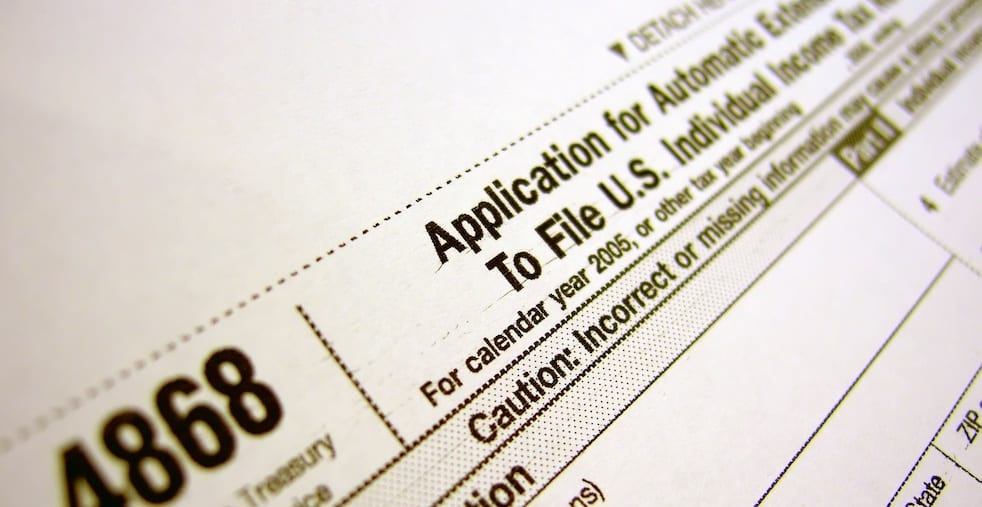
  • First, you need to apply for an extension by filing Form 4868 with the IRS. The deadline for submitting this form is the same as the deadline for filing your taxes.
  • Second, you must pay what you owe. This is usually the dealbreaker, because most people don’t know what they owe until they (or their CPA firm or accountant) prepare their tax return. So, if you’re going to file for an extension, you need to estimate what you owe and pay that when you file for the extension. If you crunch the numbers and are fairly certain you’ll get a refund, then no worries — meaning you don’t have to pay more money than you’ll eventually get back. However, if you owe anything, you’ll be charged penalties and interest for underpayment of taxes.

In this post, I answer the most commonly asked questions about tax extensions that we receive here at SWC. If your tax extension question isn’t answered below, drop our office a note using our online Contact form, or call us during business hours at (858) 487-4580.

Tax Filing Extensions FAQs

Q: What if my application for a tax filing extension is rejected?

Continue reading… Continue reading… Continue reading…

Avoid Tax Sticker Shock: Review Your Income and Withholdings

By |2022-03-22T16:46:44-07:00March 22, 2022|Categories: Taxes|Tags: , , , |0 Comments

Nobody likes to get whacked at the end of the tax year with a higher-than-expected income tax bill or a smaller-than-expected refund, but that’s what happens when you don’t have enough money withheld from your paychecks or aren’t paying enough in estimated taxes.

The United States operates a pay-as-you-go tax system, which means you as a taxpayer are expected to pay taxes on your income as you earn it, not just at the end of the year. If you owe too much at the end of the year, the government charges you a penalty. You can think of it as interest on what you underpaid for the time you underpaid.

To avoid a nasty surprise when you’re preparing your tax return at the end of the year, review your income expectations and withholdings (and estimated taxes) at the beginning of the year and adjust as needed. This is especially important if you have any self-employment or investment income or income from other sources.

Using the IRS’s Tax Withholding Estimator

To help you determine your correct tax withholding, the Internal Revenue Service (IRS) provides an online Tax Withholding Estimator that you can use for free to determine whether you need to do one of the following:

  • Complete a new Form W-4, Employee’s Withholding Allowance Certificate and submit it to your employer
  • Make or modify your estimated tax payment to the IRS

Before you start, gather your income documents, including these: Continue reading… Continue reading… Continue reading…

Go to Top
