
Deciding When to Start Drawing Your Social Security Retirement Benefits

If you or a loved one’s 62nd birthday is just around the bend, first of all, happy birthday! In addition to all the other gifts you or your loved one are about to receive on your special day, perhaps the best present of all is that you’ll be eligible to start cashing in on your social security retirement benefits — assuming, of course, that you paid into social security during your working years.

However, just because you’re eligible to start receiving social security checks at the age of 62 doesn’t mean you should. The longer you wait, the bigger your checks. You can start receiving checks when you hit that 62-year milestone; at the age of 65 (the traditional age for retirement); or at 67, which is full retirement age (FRA). You can even delay benefits until as late as age 70 (to receive the maximum benefit) or start collecting benefits anytime along that timespan.

my Social Security Login Screen

Starting benefits as soon as possible may seem like a good idea, and it may be in the right situation. The catch is, your benefits will be reduced by as much as 30 percent if you don’t wait until your full retirement age, which is likely around 67 years and change.

The bottom line is that each person’s situation is unique. What’s right for one, may not be the best choice for another. So, what should you do? That’s where we come in. The team here at SWC can sit down with you to analyze your situation and help you decide what’s best for you and your family.

In this post, I explain your options and some of the main factors to consider when deciding the best time to start collecting your social security retirement benefits.

Determining Your Eligibility

First things first. To be eligible to receive social security benefits, you must meet the following criteria: Continue reading… Continue reading… Continue reading…
How to Protect Yourself Against 2022 Tax and Unemployment Scams

It’s tax filing season — prime time for scum of the earth con artists to crawl out from under their rocks with novel ways to steal identities and scam people out of their hard-earned money.

That means it’s time for us, as one of Southern California’s premier women-owned tax planning and financial strategy firms, to let you know what to watch out for and how to protect yourself. By remaining vigilant and reporting suspicious activity to relevant government agencies and law enforcement, we can start gaining the upper hand over these criminals.

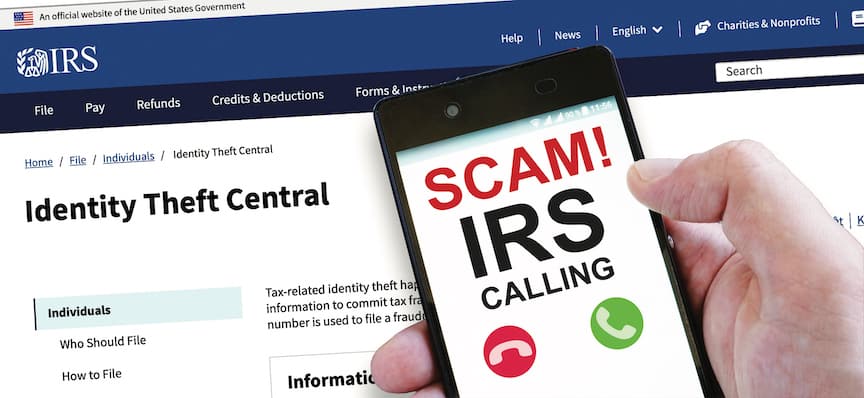
IRS scam graphic

In this post, we call your attention to four primary methods used to steal identities and tax refunds. We’ll also reveal common warning signs and offer guidance on what to do when you notice suspicious activity.

Text Message Scams

Text message scams usually involve someone pretending to be from the Internal Revenue Service (IRS). Over the last couple of years, fraudulent text messages have focused mostly on COVID-19 or “stimulus payments,” and included one or more links claiming to point to IRS websites or relevant online tools.

If you receive an unsolicited text/SMS message that appears to be from either the IRS or a program closely linked to it, take a screenshot of the text message and email it to phishing@irs.gov with the following information: Continue reading… Continue reading… Continue reading…

How Long Should I Retain My Tax Records?

By |2022-02-14T14:45:01-08:00February 14, 2022|Categories: Taxes|Tags: , , , |0 Comments

While one of your more more excitable high school classmates will tell you that purchasing and holding onto your senior yearbook in perpetuity is a graduate’s duty to their fellow classmates, maintaining tax records is actually a real part of your duties as a taxpayer. But unlike hauling around an 8.5” x 11” yearbook, keeping track of and maintaining tax records is time-consuming and a real hassle.

And if you haven’t made the transition yet to electronic documents, your tax records can take up valuable physical storage space. Clearing some of the clutter by destroying old tax records may seem like an attractive option, but in the event of an audit, you could live to regret that decision.

Tax record retention photo

So, what’s the least you can do to maintain your records and minimize storage requirements while protecting yourself in the event of an audit? In this blog post, we review tax record retention requirements and related issues to help you answer these questions for yourself.

Tax Record Retention Requirements

Every taxpayer is required by Internal Revenue Code (IRC) Section 6001 to maintain adequate tax records and to make those records available to the IRS upon request. The Section 6001 regulations also require taxpayers to keep the records for as long as they may be material to tax law administration. In that regard, the IRS Continue reading… Continue reading… Continue reading…

2022 Tax and Employer Rules and Regulations

If you own or operate a business, you’re no stranger to payroll taxes — the money you withhold from an employee’s pay to remit to government tax collectors on the employee’s behalf. You pay a portion of these taxes, and your employees pay a portion. The money collected is allocated to the following:

  • Federal Insurance Contributions Act (FICA) to fund Old Age, Survivors, and Disability Insurance (OASDI), also known as Social Security and Disability, and Medicare (health insurance for senior citizens and the disabled)
  • State Disability Insurance (SDI)
  • Federal Unemployment Insurance (FUI)
  • State Unemployment Insurance (SUI)
  • Employment Training Tax (ETT)

In today’s post, we’ll bring you up to speed on what you need to know to plan for, pay, and remain in compliance with these and other withholdings for 2022. We’ll also share information about important changes and reminders that your business needs to be aware of for the year ahead. First up, Social Security.

Social Security Tax

For 2022, the Social Security tax rate is 6.2 percent for employer and employee — unchanged from 2021. The Social Security wage base has increased from $142,800 in 2021 to $147,000 in 2022. In other words, Social Security tax applies only to the first $147,000 an employee earns, so the maximum you would withhold on behalf of the employee is $9,114.

Keep in mind that the employee’s share is only half of the total Social Security tax owed. As an employer, you are responsible for paying the other half. So, if you deduct and remit $9,114 on behalf of your employee, you are required to pay an additional $9,114 as employer.

Self-employed individuals are required to pay both “halves,” so a self-employed individual with a net income of $147,000 would pay $9,114 x 2 = $18,228 in Social Security Tax. To take some of the sting out of paying both halves of FICA, self-employed individuals receive a deduction for self-employment tax on their federal income tax return.

Medicare Tax

The Medicare tax rate is Continue reading… Continue reading… Continue reading…

Go to Top
