
Employee or Independent Contractor? The Rule That Never Happened

The more things change, the more they remain the same. Case in point: the U.S. Department of Labor’s guidelines for determining whether someone is an employee or an independent contractor. In September 2020, the Department of Labor (DOL) proposed a rule to clarify employee and independent contractor status under the Fair Labor Standards Act. This rule would have made it easier for workers to be treated as independent contractors instead of as employees. It was scheduled to take effect on March 8, 2021.

In late January 2021, a new administration moved in at 1600 Pennsylvania Avenue NW in Washington, D.C., and delayed the new rule’s effective date. Then they officially withdrew the rule. You could call it “the rule that never happened.” Whether that’s good or bad depends on your circumstances, but withdrawing the rule hasn’t made it any easier to determine whether a worker should be classified as an employee or an independent contractor.

Making this determination has always been a challenge, and it continues to be so. And the fact that some states have their own rules doesn’t help matters in the least. In this post, we explain the rules and tests to shed some light on this perplexing topic.

Why the Distinction Matters

Worker classification has always been a hot-button issue. Pro-business administrations typically lean toward relaxing the rules, so that businesses have more leeway in determining how workers are classified. Some businesses prefer to use independent contractors because they facilitate scalability and generally cost less than employees. In addition, when they have more leeway in deciding who’s an employee and who’s an independent contractor, maintaining compliance with labor laws and tax laws is easier.

Pro-worker administrations, on the other hand prefer that businesses classify more workers as employees to ensure fair treatment, compensation, and benefits. When businesses have more leeway in deciding whether a worker is an employee or independent contractor, some businesses choose to hire fewer employees or even lay off employees or place them on contract (instead of hourly pay or salary) and eliminate their protections and benefits under the law.

The Biden administration would like to see more workers classified as employees and favors an ABC Worker Classification-type Test at the federal level like the test used in several states. However, to date, no federal rule or law has been adopted that requires an ABC test.

The Economic Realities Test

Currently, the DOL uses the economic realities test to classify workers. The economic realities test considers a variety of factors, including the following: Continue reading… Continue reading… Continue reading…
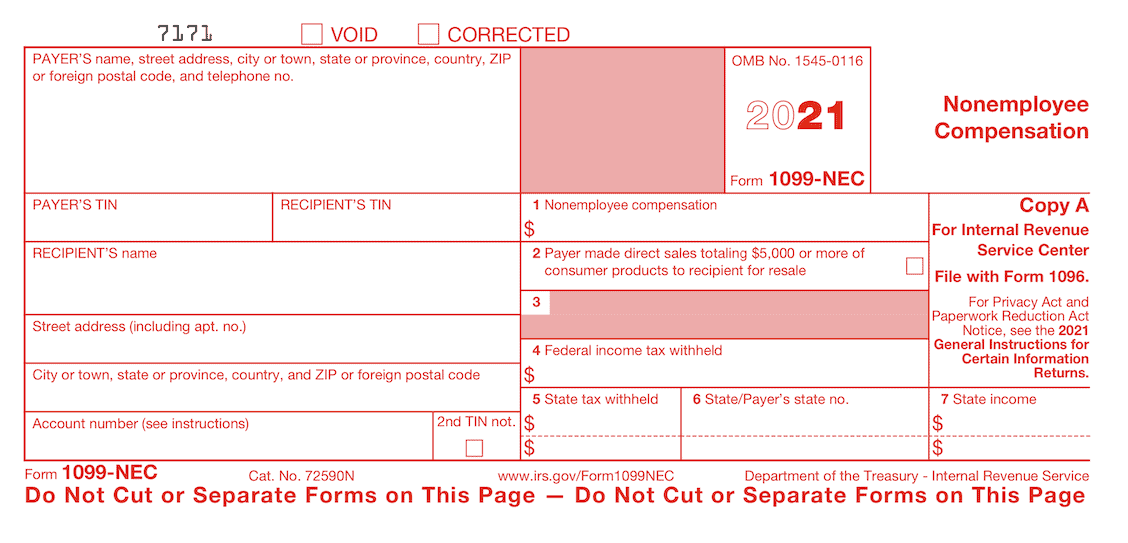
The Return of IRS Form 1099-NEC

Over the past 40 years or so, large and small businesses alike have been using Form 1099-MISC (short for miscellaneous income) to report payments of $600 or more in a calendar year to independent contractors, freelancers, sole-proprietors, and other self-employed individuals. Prior to that, these same businesses used Form 1099-NEC (short for non-employee compensation) for that purpose.

Well, the IRS (Internal Revenue Service) is turning the clock back to the 1980s with the return of Form 1099-NEC.

IRS Form 1099-NEC

We can honestly say we didn’t see this one coming. In fact, we thought that the return of Form 1099-NEC was about as likely as, say, a third Bill and Ted movie. Well, we were wrong on both counts. And the funny coincidence is that the return of the 1099-NEC and the release of the third movie (Bill and Ted Face the Music) have both occurred in the same year — 2020, as if this year wasn’t already peculiar enough.

Taking a Closer Look at Form 1099 MISC

Before we look at what changed in 2020 regarding Form 1099-MISC, let’s take a look at what we have all become accustomed to for nearly four decades. Since 1982, businesses that have paid non-employees for their work have issued them a Form 1099-MISC in lieu of a W-2 form (required to report employee compensation).

For the past 38 years, most businesses have been using the 1099-MISC form to report any payments to independent contractors, freelancers, sole-proprietors, and other self-employed individuals who met any of the following three criteria: Continue reading… Continue reading… Continue reading…

Distinguishing Employees from Independent Contractors Under California AB 5

By |2020-06-17T13:41:46-07:00June 17, 2020|Categories: California AB 5|Tags: , , , , |0 Comments

Determining whether someone working for you is an employee or an independent contractor used to be easy. If the person worked for your business a certain number of hours per week, they were an employee with rights to benefits and overtime pay (when applicable). If the person didn’t meet those criteria, he or she was considered an independent contractor.

Back in 1987, the Internal Revenue Service (IRS) developed a list of 20 factors to examine in determining whether an employer-employee relationship exists. Based on case law and judicial rulings, the IRS determined that the degree of importance of each factor varied, depending on the occupation and context in which the services were performed.

Distinguishing Employees from Independent Contractors Under California AB 5, ABC’s of AB5

But that all shifted last year here in the Golden State with the passing of California’s Assembly Bill 5 (AB5), which was signed into law by Gov. Gavin Newsom in September 2019 and went into effect on Jan. 1, 2020. That bill classifies most workers as employees, placing the burden of proof for classifying workers as independent contractors on the hiring entity (i.e., the small and medium size business, not-for-profit, or enterprise).

In essence, a worker is to be treated as an employee unless the business can prove otherwise. Another way to put it is that under AB5, it is California law — not businesses — that determines who is an independent contractor and who is not. It’s a fairly rigorous law, and both business owners and workers are understandably confused by it.

In this post, we set out to help you determine whether a person working or performing work for you is doing so as an employee or as an independent contractor under California’s AB5 law.

The ABC Test

The California bill replaces the common law test (the Borello test described later in this post) with the so-called ABC test to determine whether a worker is an employee or an independent contractor in California. And if you’re wondering why the test is named “ABC,” it’s because it features three parts — a Part A, a Part B, and a Part C.

For purposes of California employment laws, the test applies to those requiring minimum wage, overtime pay, unemployment insurance, workers’ compensation insurance, and paid family leave. As an aside, AB5 does not change how out-of-state workers are classified.

Under the rule established by AB5, hiring entities are now required to classify workers as employees unless the person in question meets all the following conditions of the ABC test: Continue reading… Continue reading… Continue reading…

Go to Top
