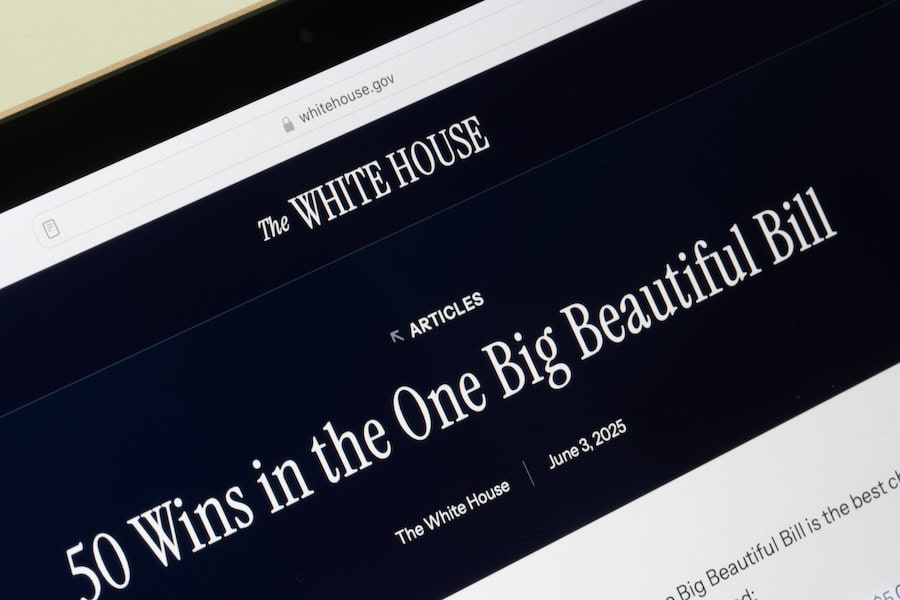
What the Passage of the One Big Beautiful Bill Mean for You and Your Business
Share This Post

On July 3, 2025, Congress passed H.R. 1, a sweeping piece of tax legislation known as the One Big Beautiful Bill Act (OBBB). The OBBB is a nearly 1,000-page tax package aimed at preserving and expanding key provisions of the 2017 Tax Cuts and Jobs Act (TCJA) and so much more.
This pro-growth bill prevents the expiration of certain tax breaks while adding a host of new tax relief measures, including “no tax on tips,” “no tax on overtime pay,” “no tax on car loan interest,” and “no tax on Social Security.” It also provides tax incentives to businesses that manufacture in the U.S. and hire more U.S. workers, and it rolls back many of the green energy credits that we’ve written about in previous blog posts.

This post summarizes the most important changes found in the new law, which was signed by the President on July 4, 2025, focusing on provisions that directly affect individual taxpayers (as compared to corporations). Understanding these updates is important, whether you’re a high net-worth individual or family member, an employee, a small-business owner or entrepreneur, a parent, or a retiree. Or maybe you just want to know how these tax code changes are likely to affect you and how you can maximize your tax savings legally.
Here’s what you need to know.
Individual Tax Rates and the Standard Deduction
The 2017 Tax Cuts and Jobs Act (TCJA) reduced most individual income tax rates. The 15 percent bracket dropped to 12 percent, the 25 percent bracket to 22 percent, the 28 percent bracket to 24 percent, the 33 percent bracket to 32 percent, and the top 39.6 percent bracket to 37 percent. The One Big Beautiful Bill Act (OBBB) locks in these rate structures permanently.
Tax Relief at a Cost? While tax relief is always welcome, according to the Congressional Budget Office (CBO), doing so will add $2.2 trillion to the federal deficit over the next decade.
The standard deduction, which was nearly doubled in 2017, is also made permanent by the OBBB and temporarily increased further for tax years 2025–2028:
- $15,750 for single filers
- $23,625 for heads of household
- $31,500 for joint filers
This expansion reduces the number of itemizers and simplifies filing for most taxpayers. It is estimated to cost $1.4 trillion over 10 years, according to the CBO.
The Child Tax Credit
The 2017 Tax Cuts and Jobs Act (TCJA) doubled the Child Tax Credit from $1,000 to $2,000 per child. The OBBB makes this adjustment permanent, increasing it temporarily to $2,500 through 2028. Inflation adjustments begin in 2026. The $500 credit for non-child dependents also becomes permanent. These changes will cost an estimated $817 billion over 10 years, according to the CBO.
The Qualified Business Income (QBI) Deduction
To maintain parity between pass-through businesses and C corporations, the 2017 Tax Cuts and Jobs Act created a 20 percent deduction for qualified business income. The new law keeps this deduction and increases it to 23 percent starting in 2026. It also expands eligibility and adjusts phaseout thresholds to avoid income cliffs. Continue reading… Continue reading… Continue reading…