
Deferring Taxes on Real Estate Sales with a Like-Kind / 1031 Exchange

By |2025-05-29T15:50:31-07:00May 29, 2025|Categories: Real Estate|Tags: , , |0 Comments

If you’re thinking about selling an investment property, the first question you should ask before anything else: How much of my profit will go to taxes?

For real estate investors, entrepreneurs, and high-net-worth individuals like the ones we work with here at SWC, the answer to that questions can be “tons!” That is, unless you know how to work the system. A like-kind exchange — also known as a 1031 exchange — enables you to sell one investment property and reinvest the proceeds into another, all while deferring capital gains taxes. It’s a savvy move, but only if you follow the rules.

In this post, we provide a clear breakdown of how like-kind exchanges work, what rules you need to follow, and how to make the most of this powerful tax-deferral strategy.

Here’s what you need to know.

Understanding the 1031 Exchange

A 1031, also known as a like-kind exchange, involves exchanging real estate used solely for business or held as an investment for other business or investment property that is the same type. For example, you may sell a rental property and buy a different rental property.

Generally, when you make a like-kind exchange, you’re not required to recognize a gain or loss under Internal Revenue Code Section 1031 (there’s where the moniker “1031 exchange” comes from.) However, if as part of the exchange, you also receive other (not like-kind) property or money, you must recognize that gain to the extent of the other property and/or money received. Under no circumstances can you recognize a loss.

Deploying a1031 exchange is a powerful strategy for real estate investors to postpone paying capital gains taxes on the sale of their investment properties. By selling one investment property and reinvesting the proceeds in another investment property of equal or greater value, you can defer capital gains and depreciation-recapture taxes. Better yet, by continuing to defer capital gains through successive like-kind exchanges, you may eventually qualify for a basis step-up, which can effectively eliminate the deferred taxes altogether!

Basis Step-Up? A basis step-up is an adjustment of the cost basis of an asset to its fair market value at the time of an owner’s death. If the cost basis of the investment property is equal to or greater than that for which the property ultimately sells, the profit from the sale is zero or negative, meaning no capital gains tax is owed.

A Sample Transaction

Capital gains taxes can be as high as 42.1 percent depending on your income, filing status, and state. If you’re a client of ours, we can provide a precise estimate. If you’re not one of our clients, we encourage you to consult your CPA to obtain an estimate based specifically on your unique situation. Before selling an investment property or a property you use exclusively for business purposes, you should always know how much you stand to lose in taxes.

Let’s look at how much money a like-kind / 1031 exchange could allow you to defer in taxes for the sale of a $1.5 million investment property in California: Continue reading… Continue reading… Continue reading…

Designating Yourself a ‘Real Estate Professional’ and Claiming Real Estate Losses Against Ordinary Income

By |2023-10-05T15:42:16-07:00October 5, 2023|Categories: Real Estate|Tags: , , , |0 Comments

Welcome to the world of real estate, where savvy individuals who have earned the right to call themselves real estate investors have more options for taking advantage of tax-saving opportunities.

For those involved in the real estate industry, “materially participating” in the management of your properties or investments and being classified as a “real estate professional” can translate to substantial tax savings, leaving you with more cash to build your real estate investment portfolio.

In this post, we explore the distinct tax advantages that come with material participation and being recognized as a real estate professional, delving into how these designations can increase deductions, minimize tax liability, and ultimately enhance your financial portfolio of real estate investments.

Whether you’re a seasoned investor or a newcomer eager to optimize your tax planning, understanding and harnessing the potential of these classifications can accelerate your progress toward meeting your real estate investment goals and your overall financial goals.

Image for Designating Yourself a ‘Real Estate Professional’ and Claiming Real Estate Losses Against Ordinary Income

Claiming Real Estate Losses Against Ordinary Income

As real estate investors know, rental real estate is ordinarily a “passive” activity. Generally, when you’re preparing your tax return, you can deduct passive losses only from passive income — income from sources such as stocks, mutual funds, royalties, and rental properties. You’re generally not allowed to deduct passive losses against ordinary income — income from sources such as salary and interest.

If all your income is passive, or if your passive gains exceed your passive losses, this restriction doesn’t impact your tax obligation. However, if your passive losses exceed your passive gains, and you have ordinary income, being able to claim passive losses against ordinary income can reduce your tax obligation.

There are two important exceptions that allow you to claim passive losses against ordinary income: Continue reading… Continue reading… Continue reading…

The Pros and Cons of a Cost Segregation Study

By |2023-02-10T17:00:38-08:00February 10, 2023|Categories: Real Estate|Tags: , , |0 Comments

If you own real estate, or you’re interested in investing in real estate as a strategy for building or increasing your net worth, then you need to know about cost segregation.

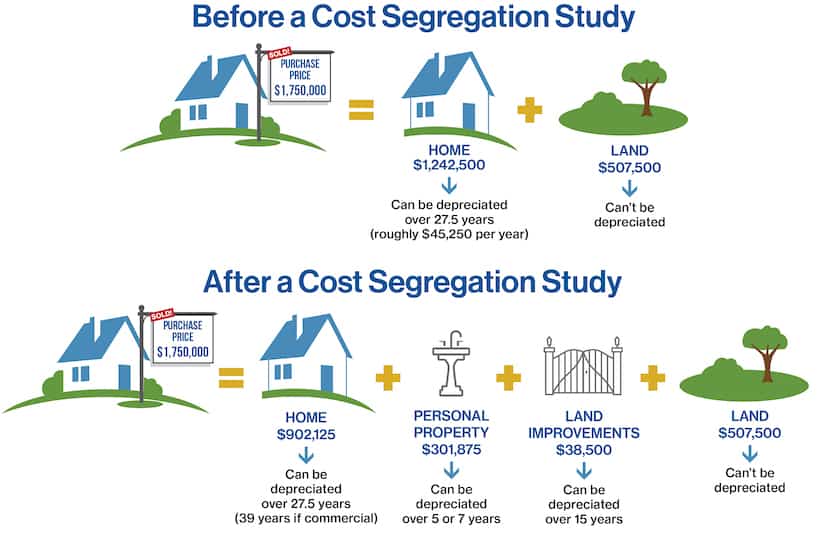
Cost segregation study illustration for residential propertyCost segregation is a technique recommended by a tax planning firm that specialize in helping its clients reduce their taxes and increase their net worth. Cost segregation allows property owners and real estate investors to reallocate the costs of a property from long-term assets (which have a useful life of 27.5 years or more) to shorter-lived assets (which have a useful life of less than 27.5 years).

This reallocation can provide significant tax benefits because shorter-lived assets are eligible for accelerated depreciation.

Depreciation 101: Depreciation is an accounting technique that distributes the cost of tangible assets such as real estate over their useful lifespan. It reflects the portion of an asset’s value that’s been utilized, allowing you to gradually pay for and generate revenue from an asset over a specified period of time.

When a property is built or purchased, the costs of the property (such as construction costs or the purchase price and cost of improvements) are typically allocated to the building and land as long-term assets. However, many of the items within a property (such as carpeting, lighting fixtures, and appliances) have a shorter useful life and can be classified as personal property. By identifying these shorter-lived assets and reclassifying them as personal property, the costs associated with them can be depreciated over a shorter period, resulting in a larger tax deduction in the early years of ownership.

Starting With a Cost Segregation Study

To add cost segregation to your tax planning approach, start by ordering a cost segregation study from a reputable firm. Here at SWC, we work with several of these firms and can recommend the right one for your particular circumstances and objectives.

When you engage a firm in a cost segregation study, a cost segregation specialist identifies and reclassifies the costs of your property, typically by examining the property and its invoices, blueprints, and other documentation. The study then allocates property costs to real property or personal property. Findings from the study can then be used by your tax planning firm — in this case, SWC — to calculate a one-time catch- adjustment. That’s because the IRS allows the Continue reading… Continue reading… Continue reading…
New Tax Credits Can Offset the Costs of Energy-Efficient Home Improvements

With energy costs soaring, some homeowners are looking for ways to make their homes more energy efficient. However, energy-efficient home improvements can be quite costly.

To make these improvements more affordable, the federal government offers tax credits to offset the costs, while some state and local governments offer additional tax credits. Thanks to the Inflation Reduction Act of 2022, two substantial federal income tax credits for energy-efficient home improvements have been extended and expanded:

  • The residential clean energy credit
  • The energy efficient home improvement credit

In this post, we cover these credits and the steps you need to take to claim them.

Tax Credits Can Offset the Costs of Energy-Efficient Home Improvements

The Residential Clean Energy Credit

The federal income tax credit for eligible energy saving home improvements, formerly called the residential energy efficient property credit, is now called the residential clean energy credit. Before explaining how the credit has changed, let’s look at how it works under the “old rules” for eligible home improvements made in 2020–2022.

The Old Rules — for 2020–2022

The residential energy property credit varies, depending on when you had the work done:

  • 26 percent of qualified expenditures for energy-saving home improvements in 2020–2021
  • 30 percent of qualified expenditures for energy-saving home improvements in 2022 (thanks to the Inflation Reduction Act)

Note that there are no income limits. Even billionaires can take advantage of these tax credits. And given the high cost of many energy-saving home improvements, this tax credit can be substantial. For example, the credit for installation of a new $35,000 geothermal system in 2022 is $10,500!

Qualified expenditures include costs for site preparation, assembly, installation, piping, and wiring for the following: Continue reading… Continue reading… Continue reading…

Keeping Pace with California Tax Law: Part 3 — Property Tax Relief for the Elderly and Disabled

Welcome to the final part of our three-part series on keeping pace with California tax law. In Part 1 of this series, we covered Prop 19, which makes it more affordable for older California homeowners to relocate within the state. In Part 2, we explained changes to the parent-child exclusion, which enables children to inherit their parent’s property and parents to inherit their children’s property without a property tax increase, subject to certain qualifications and limitations.

In this part, we bring you up to speed on additional California state-sponsored property tax relief programs for helping senior citizens on limited income and those who are legally blind or disabled. Specifically, we’re going to cover the following:

  • The Property Tax Postponement Program, which is supported by the State of California Controller’s Office
  • The Property Tax Assistance Program, which is supported by the California State Franchise Tax Board (suspended for now due to lack of funds)

Pro Tip: The inserts mailed along with your annual tax bill contain details about any property tax relief programs currently available, so be sure to read those inserts carefully to determine whether you qualify for any currently available programs.

The Property Tax Postponement Program

The State of California’s Property Tax Postponement Program (PTP) allows homeowners who are seniors, are blind, or have a disability, to defer current-year property taxes on their principal residence if they meet certain criteria, including the following: Continue reading… Continue reading… Continue reading…

Keeping Pace with California Tax Law: Part 1 — Understanding Prop 19

By |2022-08-18T12:29:46-07:00July 27, 2022|Categories: Legislation, Real Estate|Tags: , |0 Comments

Nobody can accuse California legislators of being lazy when it comes to tax legislation. They’re constantly introducing new legislation, which often presents opportunities for taxpayers to reduce their tax liability. And whether you agree with their approach or feel such relief is a poor use of taxpayer funds, staying on top of these relief measures only benefits you and the things you care about.

As one of California’s premier tax and financial strategy firms, we keep a close eye on changes to federal, state, and local tax code, so that we can fine-tune each of our client’s personalized tax-savings and wealth-building plans.

California Proposition 19

In this three-part series, we discuss three recent changes to California tax code that may impact your taxes (hopefully in a good way):

Understanding Prop 19

Prop 19 — The Home Protection for Seniors, Severely Disabled, Families, and Victims of Wildfire or Natural Disasters Act — is intended to help retirees and older homeowners sell their primary residence and relocate within California more affordably. Starting April 1, 2021, eligible California homeowners could sell their primary residence and transfer the tax base from their previous home to their next home of equal or lesser value.

For example, suppose you’ve owned a home in San Diego for the last 20 years and its assessed value is Continue reading… Continue reading… Continue reading…

Do You Need a Title Lock Service?

By |2022-07-07T16:18:33-07:00July 7, 2022|Categories: Real Estate|Tags: , , |0 Comments

Many companies these days are promoting title lock services, claiming to offer protection against scammers who commit title fraud — a crime that involves fraudulently transferring a property title or deed from the rightful owners to the scammer.

Sadly, committing title fraud is easy — the scammer simply forges or tricks the owners of the property into signing a quit claim deed or other document to relinquish ownership of the property. The scammer files the document with the county clerk to record a change of ownership — to the scammer. The scammer can then try to evict the rightful owners, claim ownership of the property for themselves, and then sell it or (more commonly) borrow money against the home and leave the homeowners and lender to battle over the mortgage payments.

Title Lock Service concepts blue banner.

Scary, yes, but does a title lock service provide sufficient protection to warrant its cost? In this post, we explain what a title lock service is and help you decide whether it’s something you want to spend money on.

What Is a Title Lock Service?

First things first — a title lock service doesn’t lock your title. It doesn’t prevent someone from filing a quit claim deed or using some other method to fraudulently claim that you transferred ownership of your property to them. All it does is notify you, after the fact, when someone succeeds in filing a document that shows a transfer of ownership. It’s sort of like when you receive a notification from an online service that someone changed the username, password, or contact information for your account and letting you know that if you didn’t do it, then something suspicious is going on, and you need to look into it.

Many counties in the U.S. are starting to offer this same service for free. All you need to do, in most cases, is fill out a form to register for the service, provide proof of identity, list the properties you own that you want to be notified about, and specify your preferred contact information — email address, phone number, or mailing address. Whenever someone tries to transfer ownership of your property or change the name on the deed, the county notifies you, so that you can take legal action to protect what’s yours.

Title Insurance Versus a Title Lock

Don’t confuse title insurance with a title lock. Title insurance is a Continue reading… Continue reading… Continue reading…

Go to Top