

Run a Google News search for COVID Scam and you’ll find an endless stream of negative articles. These range from a California doctor busted for selling a bogus “miracle cure,” to a staggering number of stories describing pandemic-related malware and phishing email scams in the past two months.
Then there are news alerts from the Federal Trade Commission, Federal Bureau of Investigation, and U.S. Department of Treasury (among others) telling us to avoid being pulled into these scams and rip-offs. It’s not like we don’t have enough on our plates with this pandemic, now we now have to watch out for criminals determined to scam us out of our money — often when we’re at our most vulnerable.
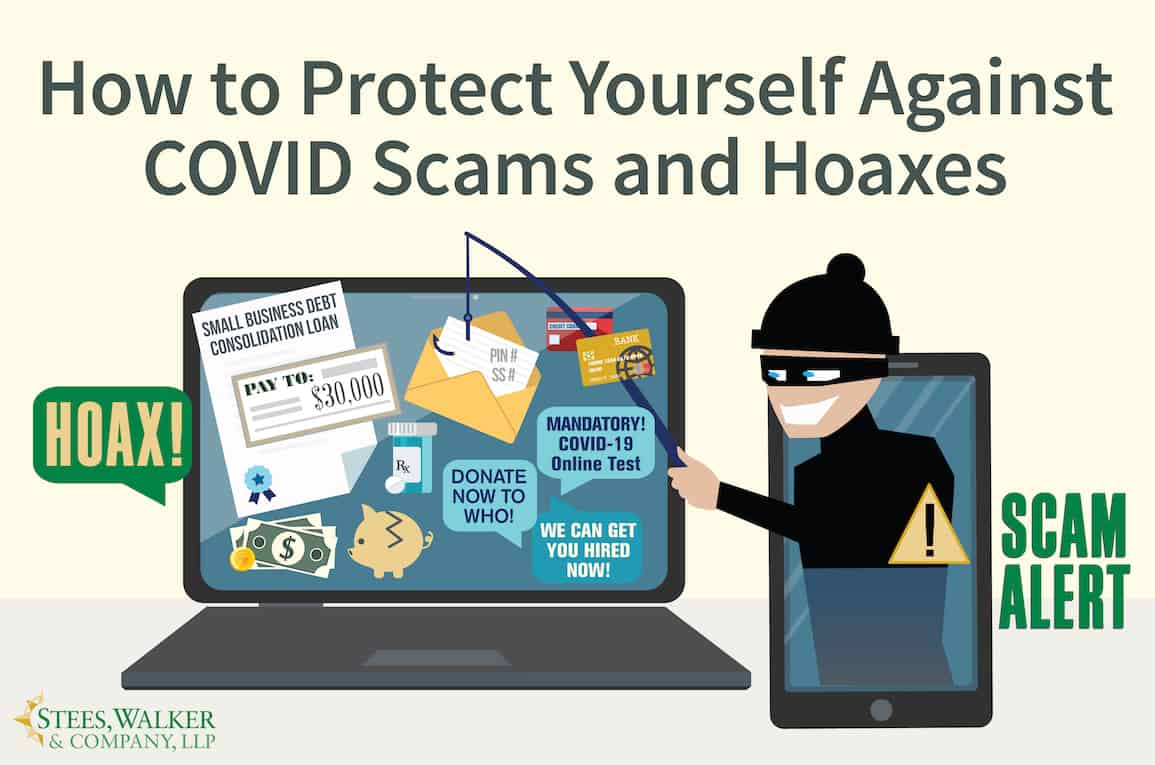
Here at Stees., Walker & Company, LLP we hate to see anyone being suckered by a clever con, so in this post, we offer guidance on how to protect yourself and your money in these difficult times.
Recognizing Common Scams and Hoaxes
One of the best ways to avoid falling victim to a scam or hoax is to recognize how the fraudsters operate. Here are some common scams and hoaxes to beware of:
- Government imposters: “Con” is short for “confidence,” and what elicits more confidence from people than the belief that they’re dealing with a trusted government representative? Con artists often reach out to people via social media, emails, phone calls, and even knocking on their doors, trying to win their confidence. They present themselves as government agents offering to help, and they use greed or fear to trigger impulsive action. For example, a recent text message claiming to come from the “FCC Financial Care Center” offers $30,000 in COVID-19 relief. Another text message impersonating the U.S. Department of Health and Human Services informs recipients that they must take a “mandatory online COVID-19 test” by clicking a certain link. Whenever someone claims to be from the government threatening punitive action or offers to help, tread very carefully.
- Scams related to stimulus payments: Taxpayers should be on the lookout for IRS impersonation calls, texts, and email phishing attempts about the COVID-19 Tax Relief and Economic Impact Payments (the so-called stimulus checks). The con artists involved in these scams are looking to steal your stimulus payment or your identity. Take the following precautions:
- DON’T sign over your Economic Impact Payment check to them.
- DON’T verify your personal or banking information online or over the phone.
- DON’T agree to let them help you get your tax refund or Economic Impact Payment faster.
- If you obtain a check made out in an amount that appears odd or too good to be true and instructing you to verify details on the check in order to cash it, DON’T.
- Work-from-home fraud: People who are at home and out of work are vulnerable to work-from-home scams, which usually require the recipient to pay for access to information about work-from-home opportunities. Whenever you’re required to pay someone to get a job, beware.
- Debt-relief fraud: Con artists are increasingly using student loan repayment plans and debt consolidation offers to scam people out of their money or personal information. Consumers aren’t the only target. Small businesses are also getting scam calls about virus-related funding or loans.
- Investment fraud: One of the most lucrative schemes for criminals is to offer you an opportunity to invest in a test, cure, or treatment for the virus. Any offer like this should be treated with extreme caution.
- Healthcare scams: Watch out for scam and hoax texts, email messages, and robocalls offering “free” home test kits, coronavirus cures, health insurance, supplements to prevent infection, or medical equipment. Don’t click any links in such messages, and never accept a medical treatment, follow medical advice, or take a virus test from anyone other than your doctor, pharmacist, or local health department. Some of the hoaxes out there are promoting prevention, treatments, or cures that are dangerous and even fatal.
- Charity scams: The most nefarious scams are those that play on your good nature to steal your money. The fraudster may ask for money to help himself, a family member, an organization, or a cause. The World Health Organization (WHO) recently issued a warning about phone calls and text messages claiming to come from WHO requesting donations.
- Bogus products: The Federal Trade Commission and the U.S. Food & Drug Administration have posted consumer warnings about fake websites and phishing emails used to promote bogus products. Opportunists are also making robocalls to offer HVAC duct cleaning as a way to “protect” your home and family from the virus.
- Hoaxes designed to instill fear and panic: Text and e-mail messages and social media posts may claim that the government is about to order a mandatory national two-week quarantine or instruct you to go out and stock up on supplies. The messages can appear to be from the National Security Council, the Federal Emergency Management Agency (FEMA), or even from a next-door neighbor.
Knowing What the Government Will and Will Not Do
To protect yourself against scams that involve people claiming to be from the government, be aware of what authentic government agencies and their agents will and will not do:
- No one from the government will call or text you to verify your personal information or bank account details in order to release funds or send you a check.
- If you’re eligible to receive a stimulus check, it will be deposited directly into your bank account, or you will receive a check in the mail.
- The IRS does not charge a fee to issue the payment.
Knowing What You Should and Shouldn’t Do
Take the following precautions to protect yourself against scams and hoaxes:
- Don’t respond to texts, emails, or phone calls about checks from the government. If you think you’re qualified to receive a stimulus payment from the U.S. government, visit Get My Payment webpage to check the status of your payment. Remember that government agencies will never call you to ask for personal or financial information or for money.
- Don’t respond to texts, emails, or phone calls from unfamiliar sources or any others that appear suspicious. Especially, don’t click any links in texts or email messages unless they come from a known and trusted source and are links you were expecting to receive. If a friend sends you a text with a suspicious link that seems out of character, call them to make sure they weren’t hacked. Keep in mind that scammers can spoof phone numbers and email addresses to make them appear as though a friend or neighbor is calling.
- Ignore online offers for vaccinations and home test kits. No products are proven to prevent or treat COVID-19 at this time, and if such products were available, you’d probably have to see your doctor to gain access to them.
- Hang up on robocalls. Scammers are using illegal robocalls to pitch everything from low-priced health insurance to work-at-home schemes. Either don’t answer these calls or hang up on them.
- Beware of emails claiming to be from the CDC or WHO. Delete these email messages without opening them, and never ever click a link in any email message unless you fully trust the sender and the message looks legitimate. To access accurate information about the coronavirus, visit legitimate sites, such as Coronavirus.Gov and USA.Gov/oronavirus.
- Do your homework before donating money. Always check on a charity (for example, by calling or visiting its official website) before donating. Never donate in cash, by gift card, or by wiring money. (To find out more about charity scams, visit the Federal Trade Commission Charity Scam Alter webpage.)
- Never share your personal or financial information via email, text messages, or over the phone. Be especially cautious if you’re being pressured to share any information or make a payment immediately. Any information you share can be used to steal your identity.
- Watch out for fake websites and social media requests for money or personal information. Search Google for the organization’s official website and go directly to that website for accurate information. Official IRS information about the COVID-19 pandemic and Economic Impact Payments (so-called stimulus checks) can be found on the Coronavirus Tax Relief page on IRS.gov.
- Seek a second opinion. Before taking any action, ask someone you trust what they think. Con artists will often try to discourage would-be victims from consulting someone else, because that someone else will ask questions and encourage the would-be victim to think twice about handing over any money or information.
- Learn more about scams. Visit the FCC Consumer Help Center and the FCC Scam Glossary. You can also file a complaint about such scams at FCC Complaint webpage.
If you think you’ve been a victim of a coronavirus scam, contact law enforcement immediately.
Why the Uptick in Scams Right Now?
With all the problems we’re facing in the world right now, especially due to the coronavirus, most people are pulling together and helping one another. Unfortunately, a small minority — the criminal element within our society — sees our time of weakness as a golden opportunity to scam people out of their money.
They see a vulnerable population out there they can prey upon. People are scared and looking for help. They’re trying to protect themselves and their families and earn a decent living. Fear, desperation, and sometimes greed can drive people to act carelessly and fall into the traps set by clever con artists.
During this time, we encourage you to keep a cool head and to think carefully before you act. Taking time to pause and think is often all that’s required to keep your money and your personal and financial information out of the hands of con artists.
– – – – – – – – –
About the Author: Laura Stees, CPA is a partner and business strategist with Stees, Walker & Company, LLP — a San Diego, Calif.-based boutique tax consulting firm focused on personalized tax and financial guidance to individuals and businesses.
Disclaimer: The information in this blog post about COVID-19 scams and frauds is provided for general informational purposes only and may not reflect current financial thinking or practices. No information contained in this post should be construed as financial advice from the staff at Stees, Walker & Company, LLP, nor is this the information contained in this post intended to be a substitute for financial counsel on any subject matter or intended to take the place of hiring a Certified Public Accountant in your jurisdiction. No reader of this post should act or refrain from acting on the basis of any information included in, or accessible through, this post without seeking the appropriate financial planning advice on the particular facts and circumstances at issue from a licensed financial professional in the recipient’s state, country or other appropriate licensing jurisdiction.
Leave A Comment