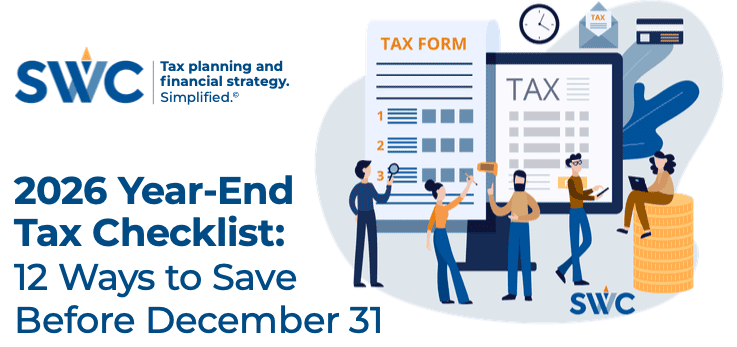
2026 Year-End Tax Checklist: 12 Ways to Save Before December 31
Share This Post

The end of 2026 is fast approaching, which means the window for taking advantage of certain tax-saving opportunities is getting smaller. The One Big Beautiful Bill Act (H.R. 1), signed into law in July 2025, extended several existing tax breaks and introduced new deductions that may help individual taxpayers reduce their 2026 federal income tax liability. With some planning, you may be able to take advantage of these provisions before the year ends.
Here at SWC, we hate to see anyone pay more in taxes than they’re legally obligated to. That’s why we offer year-end tax projection appointments for our clients from October through December. During these meetings, we review your finances and estimate your tax liability. We also look for opportunities to reduce the amount you may owe when you file your return.
To help you get started, we’ve put together a dozen tax-saving tips worth considering before Dec. 31, 2026. Some involve relatively simple adjustments, while others may require help from our CPAs. All are intended to help you make informed decisions about your taxes and put more of your money toward building long-term wealth.
Tip No. 1: Review Your Tax Withholdings and Estimated Payments
One of the easiest ways to avoid an unpleasant surprise at tax time is to review how much federal income tax you’ve already paid for 2026. If your employer withholds taxes from your paycheck, or you make quarterly estimated tax payments, you’ll want to make sure you’ve paid enough to avoid an underpayment penalty.
You can avoid the federal underpayment penalty by paying at least one of the following amounts through withholding and timely estimated payments:
- 90 percent of your 2026 tax liability.
- 100 percent of your 2025 tax liability.
- 110 percent of your 2025 tax liability if your 2025 adjusted gross income (AGI) exceeded $150,000, or $75,000 if you’re married filing separately.
These are general safe-harbor rules. Other requirements and exceptions may apply depending on your circumstances, which we can cover with you during your year-end tax projection appointment.
SWC Recommends: If you received unexpected income, sold appreciated investments, or experienced a significant change in your financial situation, you may need to adjust your tax payments before year-end.
One option is to increase the federal income tax withheld from your remaining paychecks. Unlike estimated tax payments, which count when paid, withholding is typically treated as though it occurred evenly throughout the year. That distinction may help reduce an underpayment penalty resulting from insufficient payments earlier in 2026.
We here at SWC can prepare a year-end tax projection to estimate what you owe and help you determine whether adjusting your withholding or estimated payments makes sense.
Tip No. 2: Consider Bunching Your Itemized Deductions
Every year, you have a choice between taking the standard deduction or itemizing eligible expenses such as mortgage interest, charitable contributions, medical expenses, and state and local taxes.
For 2026, the federal standard deduction is: Continue reading… Continue reading… Continue reading…