

Did you know that if you have a motor vehicle and a business, you may have a tax deduction coming your way? It’s true. In many cases, you can deduct from your business profits the cost of buying, driving, and maintaining that vehicle. And if you use it exclusively or almost exclusively for work, you may be able to get the government to pay a good chunk of the expenses related to that vehicle (in the form of money you save on taxes).

That’s only fair. Every penny you put into driving to deliver product or perform a service for your customers is a penny out of your business profits!
In this blog post, Part 9 in our Small Business Guide to Reducing Your Tax Burden Legally series, we cover how it may be possible to claim a deduction on a qualifying car, truck and related expenses.
Two Ways to Claim Vehicle Expenses
In these United States, the Internal Revenue Code provides for two different ways to claim vehicle expenses:
- Actual expenses: You claim the business use percentage (BUP) of all expenses related to a vehicle, including fuel cost, auto insurance, lease payments (or loan interest and depreciation), personal property tax, repairs/maintenance (oil changes, tires, etc.), and car washes. For example, suppose you use a vehicle 75 percent for business and 25 percent for personal use, and your total vehicle expenses are $8,000 for the year. Your deduction would be $8,000 x 0.75 = $6,000.
- Standard mileage: You multiply the number of miles you drove the vehicle for business by the standard per-mile rate, which is 57.5 cents for the year 2020. For example, if you put 8,000 business miles on a vehicle 8,000 x 57.5 = $4,600. Using this method, you can also deduct the business use percentage of vehicle registration fees and taxes, vehicle loan interest, and tolls and parking fees. (Note: You cannot use the standard mileage method if you use five or more vehicles in your business, or you use your vehicle for hire; for example, taxi, Lyft, Uber, etc.)
Many small-business owners choose the standard mileage option because it’s so straightforward in terms of calculations and record-keeping. All you need is your odometer meter reading at the beginning and end of the year and a log of the number of miles you drove for business (which you should keep regardless of the method you use to calculate your deduction). You don’t need a receipt for every time you fuel up or take your vehicle in for an oil change.
However, using the easy method could cost you money. Every year, the American Automobile Association (AAA or more commonly “Triple A”) conducts in-depth research into vehicle operating costs. If you’re choosing to take the standard deduction for a vehicle that costs more than 57.5 cents/mile, could be losing money by not claiming your actual expenses.
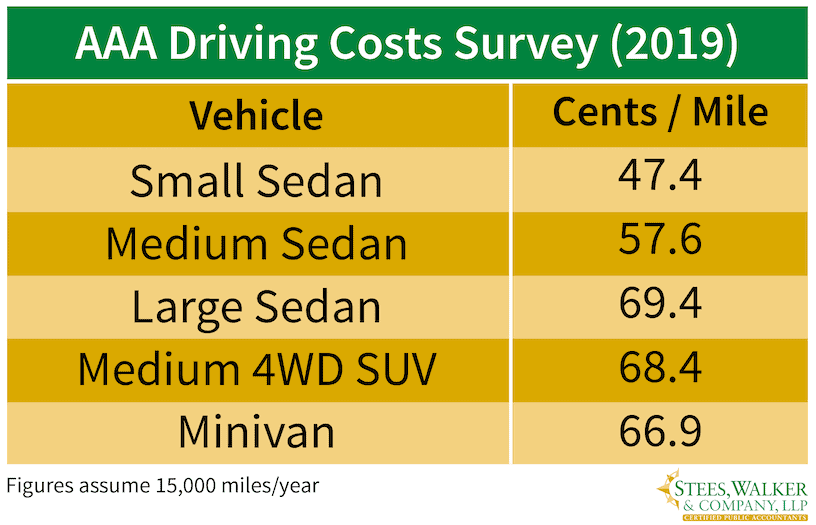
In the following sections, we lead you through the three-step process for calculating your vehicle deduction based on actual expenses.
Step 1: Keep Detailed Records
The most difficult aspect of claiming actual expenses is that you must keep detailed records, not only of all your expenses but also of all your business trips. Here’s a list of the records you need to keep:
- Odometer reading at the beginning and end of the year, so you can calculate the total number of miles the vehicle was driven each year.
- A record of every business trip, including the mileage driven, the date, the departure and destination points, and the names and relationships of the parties (for example, customers or partners).
- Fuel receipts
- Maintenance and repair receipts (including oil and tires)
- Registration form showing vehicle registration fees and taxes
- Records of vehicle loan or lease payments
- Cost of the vehicle and year placed in service (to calculate depreciation)
- Car wash/detailing receipts
- Invoice or other record of vehicle insurance payments
- Receipts of any tolls, parking fees, or garage rental fees paid
Step 2: Calculate Your Business Use Percentage
The next step to calculating your vehicle deduction based on actual expenses involves calculating your business use percentage (BUP) for your vehicle. The Internal Revenue Service (IRS) allows you to divide your trips into three categories:
- Business
- Commuting
- Personal
Ordinary personal and commuting trips are nondeductible. Trips from your home to your first business stop, and trips from your very last business stop to your home are considered personal (unless, of course, your home is your principle place of business). (Note that trips around town to the post office, copy center, bank, and other stops along the way where you perform no business-related service yourself do not qualify as “business.”) In short, personal and commuting miles don’t count as business miles.
And in case you’re wondering, yes, you can deduct the cost of branding your vehicle with your company name and logo.
Next, the IRS gives you these four (4) ways to track what qualifies as “business” miles:
- The Brute Force method: Here, you record every business mile you drive for the fiscal year. You then divide your business mileage by your total mileage for the year. (If you use more than one vehicle for business, this is the method you have to use.)
- The 90-days method: With this method, you record your business miles for a typical 90-day period. Next, divide that amount by your total mileage for that period to calculate BUP, then use that percentage for the entire year.
- The First Week method: With the first week method, you record your business miles for the first week each month. You then divide that by your total miles for that period and use it for the entire month.
- The Simplified method: Here, you record your starting and ending mileage for a 90-day period. Record your personal and commuting miles for that period and assume all the rest of your miles are for business. Calculate your BUP and use it for the entire year.
Another in case you’re wondering… yes — travel between temporary business stops is deductible. For example, if you leave home, make four business stops, meet a business prospect for lunch, then drive home, your mileage between your first stop and the restaurant is deductible. Also, if you have a regular business stop, one that you make at least eight to 10 times in a six-month period and that you expect to last less than a year, you can count those as business miles. And if your home is your principal place of business, then all business trips are deductible.
Step 3: Calculate Your Vehicle Deduction
After you’ve calculated your BUP (business use percentage), you have two ways to calculate your vehicle deduction based on actual expenses:
- Total all expenses for your vehicle:
-
- Depreciation and interest (if you purchased your vehicle)
- Lease payments (if you’ve leased your vehicle)
- Insurance
- Gasoline, oil, and car washes
- Tires, maintenance, and repairs
- License and registration fees
- Personal property tax payments
- Parking and tolls
- Multiply the total by the vehicles BUP.
- Repeat Steps 1 and 2 if you have more than one vehicle you use for business.
Compare Methods
Which approach saves the most? There’s one way to find out — try them both and see for yourself. Generally, if you log a lot of business miles, the standard mileage method is likely to save you the most money — especially if your vehicle expenses are relatively low. For example, you drive a vehicle that’s been paid off and requires little in maintenance and repairs. If you’re a real road warrior and log 25,000 or more business miles per year, you’ll almost certainly come out ahead with the standard mileage method, regardless of the vehicle you drive.
What if you’ve been using the standard mileage method because it’s easier, or because your tax preparer told you it was all the same, and you discover you ought to be taking actual expenses. What now? You can switch from the standard mileage to the actual expense method if you own your car – but not if you lease.
Unfortunately, the reverse isn’t true. You can’t switch from actual expenses to the mileage allowance.
Another deduction that small-business owners tend to underutilize is the deduction for qualifying meals and entertainment. Suppose you and your life partner, who also happens to be your business partner, discuss business over lunch — that’s deductible. Office holiday parties, annual picnics, office retreats, team lunches — all deductible. Check back in next week to find out how to qualify for these deductions and reduce your tax bill without overstepping your bounds.
– – – – – – – – –
Disclaimer: The information in this blog post about deducting qualifying vehicle expenses is provided for general informational purposes only and may not reflect current financial thinking or practices. No information contained in this post should be construed as financial advice from the staff at Stees, Walker & Company, LLP, nor is this the information contained in this post intended to be a substitute for financial counsel on any subject matter or intended to take the place of hiring a Certified Public Accountant in your jurisdiction. No reader of this post should act or refrain from acting on the basis of any information included in, or accessible through, this post without seeking the appropriate financial planning advice on the particular facts and circumstances at issue from a licensed financial professional in the recipient’s state, country or other appropriate licensing jurisdiction.
Leave A Comment