

If you believe taxation is the price we pay for civilization and the social and civil institutions it supports, as it was suggested back in 1852 by a committee appointed by Vermont Gov. Charles K. Williams, then Happy Tax Day to you!
If on the other hand, you view taxes as an involuntary extraction from those engaged in economic production to those who control coercive power producing no reciprocal benefit, then read no further.
With today being Tax Day, we’ve decided here at SWC to flip the script on the dread associated with filing tax returns. Instead of replaying vinyl of The Beatles’ “Taxman,” quoting biblical references to the tax collectors in the temple, or reflecting on tea in Boston Harbor, we’ve chosen to step to the tune of the happy dance.
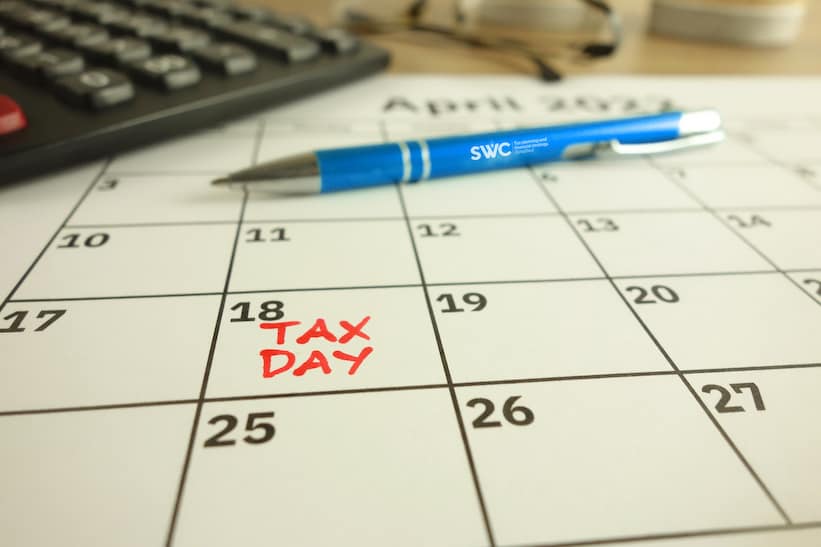
Now you’re probably thinking, “Of course CPAs and tax planning firms celebrate Tax Day. That’s how they make bank!” But if you take a deeper dive, beyond the oft-onerous task of tax preparation and the pain of paying those taxes and occasional penalties, there’s plenty to celebrate.
And so, in this post we shine the spotlight on all the positive aspects associated with paying taxes and filing tax returns.
Ka-Ching! Receiving a Tax Refund
Many momentous occasions bring joy to people’s lives — graduations, weddings, anniversaries, birthdays, and retirements among them. After preparing tax returns for tens of thousands of clients, the team here at SWC can add to that list the joy of receiving an annual tax refund, especially when it exceeds our client’s expectations.
In 2020, nearly 170 million people filed tax returns, and about 74 percent of them received a refund, which accounts for approximately 126 million refunds! The average refund: $2,549. Even though you earned it, it feels like easy money, free money, and it is certainly a cause for celebration.
Owing Taxes: A Celebration of Financial Success
Owing taxes at year’s end, especially when you already paid a hefty sum over the course of the year, can knock the stuffing right out of your Thanksgiving turkey. But think about it: As we often tell our clients, owing taxes means you earned a lot of money — probably more than you expected. So, you have plenty to celebrate. Do the happy dance as you pay one of the costs of achieving financial success.
Paying Income Taxes Makes Us Happy
In an article he wrote for Psychology Today, Utpal Dholakia Ph.D., postulates that contrary to popular belief, “many Americans actually like to pay their income taxes.” It lights up the pleasure centers of our brains.
In the U.S. and elsewhere around the world, people view taxes as an opportunity to honor their civil duty and moral obligation as a member of society. Sure, we get upset when we see politicians squander our tax money or use it to fund programs we disagree with, but the taxes we pay provide us with a sense that we are active participants in something bigger than ourselves.
In fact, research supports the fact that paying taxes makes us happier:
- Economists William Harbaugh and Daniel Burghart, along with psychologist Ulrich Mayr, studied the brain activity of 19 women while they played a game involving personal finances. Each was given $100, a portion of which they could donate to a food bank. Regardless of whether they contributed voluntarily or were required to do so, the women experienced increased activation in one of the reward centers of the brain.
- Italian economists Diego Lubian and Luca Zarri examined the connection between tax morale and happiness. They measured tax morale through responses to statements such as “Paying taxes is one of the basic duties of citizenship” and “It is right to pay taxes because it helps the weak.” They measured happiness through responses to questions such as, “Looking at every aspect of your life, how happy would you say you are?” They found that an increase of one standard deviation in a participant’s tax morale was associated with an increase of a half a standard deviation in their stated happiness.
- In another study comparing East Germans (who formerly lived under a communist regime) with West Germans (who lived in a democratic state and paid taxes), researchers concluded that former East Germans “tend to be relatively more happy to pay taxes.”
- In a study of 14 Eastern and Central European countries, political scientists Ada Ferrer-i-Carbonell and Klarita Gërxhani found that those who evaded taxes reported a significantly lower level of subjective well-being (or happiness).
It Could Be Worse
According to an article written by Drew DeSilver of the Pew Research Center titled “Among developed nations, Americans’ tax bills are below average,” U.S. taxes are low compared with those of 39 other developed economies.
Using 2015 data from the Organization for Economic Cooperation and Development’s database of benefits, taxes and wages, Pew researchers compared taxes across four groups:
- Single employed person with no children
- Married couple with two children, both parents working
- Married couple with two children, one parent working
- Single working parent with two children
In all cases, “the U.S. was below the 39-nation average — in some cases, well below.”
Enjoying the Fruits of Our Taxes
In Oscar Wilde’s novel The Picture of Dorian Gray, Lord Henry says, “Nowadays, people know the price of everything and the value of nothing.” The same can be said of people who complain about having to pay taxes. They focus on the cost, to them, and often overlook the individual and collective benefits they receive.
In her article for Business Insider, “Why do we pay taxes?,” Christiana Sciaudone writes, “Taxes, though not particularly popular, are key to fostering economic growth and development and to achieving the common goal of a prosperous and functional society.”
In the U.S., individual taxpayers generally pay federal, state, and local income taxes, sales taxes, property taxes, excise taxes, capital gains taxes, and estate (or wealth) taxes. In addition, businesses pay corporate income taxes and payroll taxes along with countless fees and fines. It all amounts to trillions of dollars a year. So where does all that money go?
Where Does All the Tax Money Go?
When we pay taxes, we need to remind ourselves what we are receiving in return for them. The benefits can be broken down into three levels:
- Federal: At the federal level, our taxes fund Social Security and healthcare, which includes Medicare, Medicaid, Children’s Health Insurance Program, and Affordable Care Act market subsidies. It also funds national defense and security-related international activities; safety net programs; interest on national debt; benefits for federal retirees and veterans; infrastructure; education; economic growth; and science and medical research.
- State: At the state level, our taxes primarily fund elementary and secondary education, public universities and community colleges, healthcare (Medicaid), transportation, infrastructure, public housing, and corrections (state prisons and related institutions).
- Local: At the local level, taxes are also used for education (K-12 public schools), transportation, and infrastructure, but also for safety (police and firefighters), sanitation (trash removal), and parks and recreation.
If Tax Day generally gets you down, we encourage you to look at the brighter side of the taxes you pay. If you owe taxes, we don’t expect you to do the happy dance in celebration of having to pay, but instead of getting you down, focus on the positives — your financial success, your ability to contribute more to building a strong country and helping the less fortunate, and the many benefits you’ll receive thanks to the taxes that you and many of your fellow successful citizens have funded.
On the other hand, if you’re one of the 70-plus percent fortunate enough to receive a tax refund, we might expect you to do the happy dance.
Leave A Comment