
Understanding Proposition 19: Property Tax Planning for California Homeowners

By |2026-07-23T16:27:11-07:00July 23, 2026|Categories: California Tax Planning|Tags: , |0 Comments
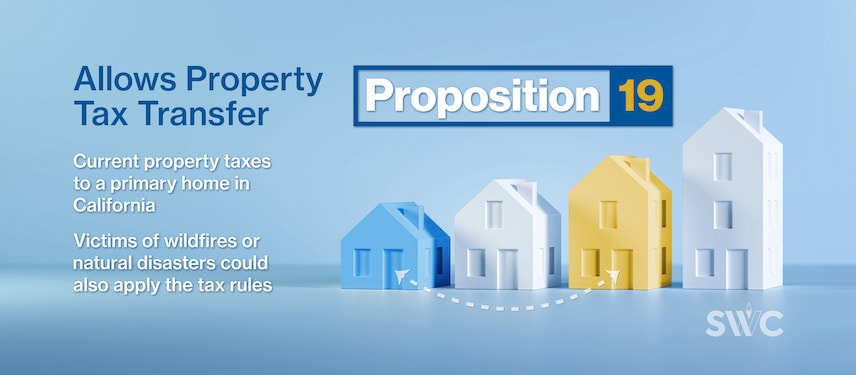
Start Here: Prop 19 (aka, Assembly Constitutional Amendment No. 11) allows certain California homeowners to transfer the taxable value of their principal residence to a replacement principal residence anywhere in the state. It also provides a limited property tax exclusion for qualifying transfers of a family home or family farm between generations. Read this post to determine whether taking advantage of Prop 19 might reduce the property tax impact of moving within California or transferring qualifying property to a child or grandchild. Timing, occupancy, property value, and filing requirements can affect the available property tax relief. (If you’d like help, contact our San Diego tax planning and financial strategy firm by phone at (858) 487-4580 or email: admin@swc.cpa. We’re here to help!)

California property laws continue to evolve, creating both opportunities and tax planning considerations for homeowners and families alike. Proposition “Prop” 19, for instance, changed the rules governing certain property tax transfers, affecting homeowners who relocate within California as well as families planning to transfer real estate from one generation to the next.

As one of California’s premier tax planning and financial strategy firms, we closely monitor changes to federal tax law and the state’s property tax rules. That ongoing attention allows us to incorporate new planning opportunities into each client’s personalized tax-saving and approach to wealth-building while helping them avoid costly surprises.

In this SWC blog post, we discuss two parts of Prop. 19 that may affect your property taxes:

  • Base year value transfers for qualifying homeowners who relocate within California
  • Intergenerational transfer exclusions for qualifying family homes or family farms

Understanding California Prop 19

California voters approved Prop 19 on Nov. 3, 2020. Senate Bill 539 later established procedures for its intergenerational exclusions and base-year value transfers, which is just a fancy way of saying a set the rules for property tax transfer and family inheritance provisions.

As a result of the new law, beginning April 1, 2021, qualifying California homeowners could sell their principal residence and transfer its taxable value to a replacement principal residence anywhere in California. A homeowner may also qualify based on age or a severe and permanent disability. Separate rules cover qualifying victims of wildfire or a governor-declared disaster.

Understanding Taxable Value: Taxable value simply means the property’s base year value plus inflationary adjustments. You may also see this amount called the factored base year value.

For example, suppose you’ve owned a home in San Diego for the last 20 years and its taxable value has reached $400,000. Assume the County Assessor determines that the home’s current market value equals $1 million.

If you sell that home and buy another principal residence anywhere in California with an equal or lower market value, you may transfer the $400,000 taxable value to the home you bought. In other words, your property tax would generally begin with the transferred $400,000 taxable value rather than the replacement home’s full market value.

A higher-priced home may also qualify.

Suppose the replacement home has a market value of $1.3 million and you purchase it before selling the original home. The difference in market value equals $300,000: Continue reading… Continue reading… Continue reading…

Keeping Pace with California Tax Law: Part 2 — The Parent-Child Exclusion

By |2022-08-18T12:28:56-07:00August 9, 2022|Categories: Legislation|Tags: , |3 Comments

This week, in Part 2 of our three-part series on keeping pace with California tax law, we bring you up to speed on the parent-child exclusion, which applies to any real property purchases or transfers between parents and children. In last week’s post, we covered Prop 19, which makes it more affordable for older homeowners to relocate in California.

In a nutshell, the parent-child exclusion enables children to inherit their parents’ property and parents to inherit their children’s property without a property tax increase, subject to certain qualifications and limitations. Prop 19 changed the way the parent-child exclusion works as of Feb. 16, 2021.

Parent-Child Exclusion in California

The Parent-Child Exclusion Before and After Prop 19

In California, real property, such as a home, is reassessed only upon a change in ownership, but when the change in ownership is within a family — specifically parent to child, child to parent, or grandparent to grandchildren — you can file for a reassessment exclusion to prevent a reassessment or reduce the reassessed value.

Before Prop 19 (effective Feb. 16, 2021), here’s how the parent-child exclusion worked:

  • Parents (transferor) could transfer their primary residence to their child/children (transferees) without a reassessment.
  • There was no limit on the value of the home that could be transferred.
  • The child/children could live in the home, use it as a vacation home, or rent it out.
  • Parents could transfer up to $1 million of California real property other than their primary residence to a child/children without reassessment. If the assessed value is more than $1 million, the first million dollars is transferred without change, and only the balance is reassessed.

Prop 19 changed the rules. For any property transfers occurring on or after Feb. 16, 2021, the parent-child exclusion works like this: Continue reading… Continue reading… Continue reading…

Keeping Pace with California Tax Law: Part 1 — Understanding Prop 19

By |2022-08-18T12:29:46-07:00July 27, 2022|Categories: Legislation, Real Estate|Tags: , |0 Comments

Nobody can accuse California legislators of being lazy when it comes to tax legislation. They’re constantly introducing new legislation, which often presents opportunities for taxpayers to reduce their tax liability. And whether you agree with their approach or feel such relief is a poor use of taxpayer funds, staying on top of these relief measures only benefits you and the things you care about.

As one of California’s premier tax and financial strategy firms, we keep a close eye on changes to federal, state, and local tax code, so that we can fine-tune each of our client’s personalized tax-savings and wealth-building plans.

California Proposition 19

In this three-part series, we discuss three recent changes to California tax code that may impact your taxes (hopefully in a good way):

Understanding Prop 19

Prop 19 — The Home Protection for Seniors, Severely Disabled, Families, and Victims of Wildfire or Natural Disasters Act — is intended to help retirees and older homeowners sell their primary residence and relocate within California more affordably. Starting April 1, 2021, eligible California homeowners could sell their primary residence and transfer the tax base from their previous home to their next home of equal or lesser value.

For example, suppose you’ve owned a home in San Diego for the last 20 years and its assessed value is Continue reading… Continue reading… Continue reading…

Go to Top
