
California Tax Update: Six 2026 Changes That Could Affect Your Finances
Share This Post

California tax developments can sound deceptively simple when reduced to a headline. A new rebate might look like an automatic savings opportunity. A change in retirement-account taxation might appear relevant only when you file your return. And adding someone to your LLC may seem like a routine ownership change.
In practice, the impact often depends on your individual circumstances and, in some cases, decisions you make before the next tax season arrives. Your residency history, prior tax treatment, family circumstances, business structure, and timing can all change the result. That’s why we continually monitor developments that may affect you, our clients, and consider them within the larger tax planning picture we already understand about each client’s situation.
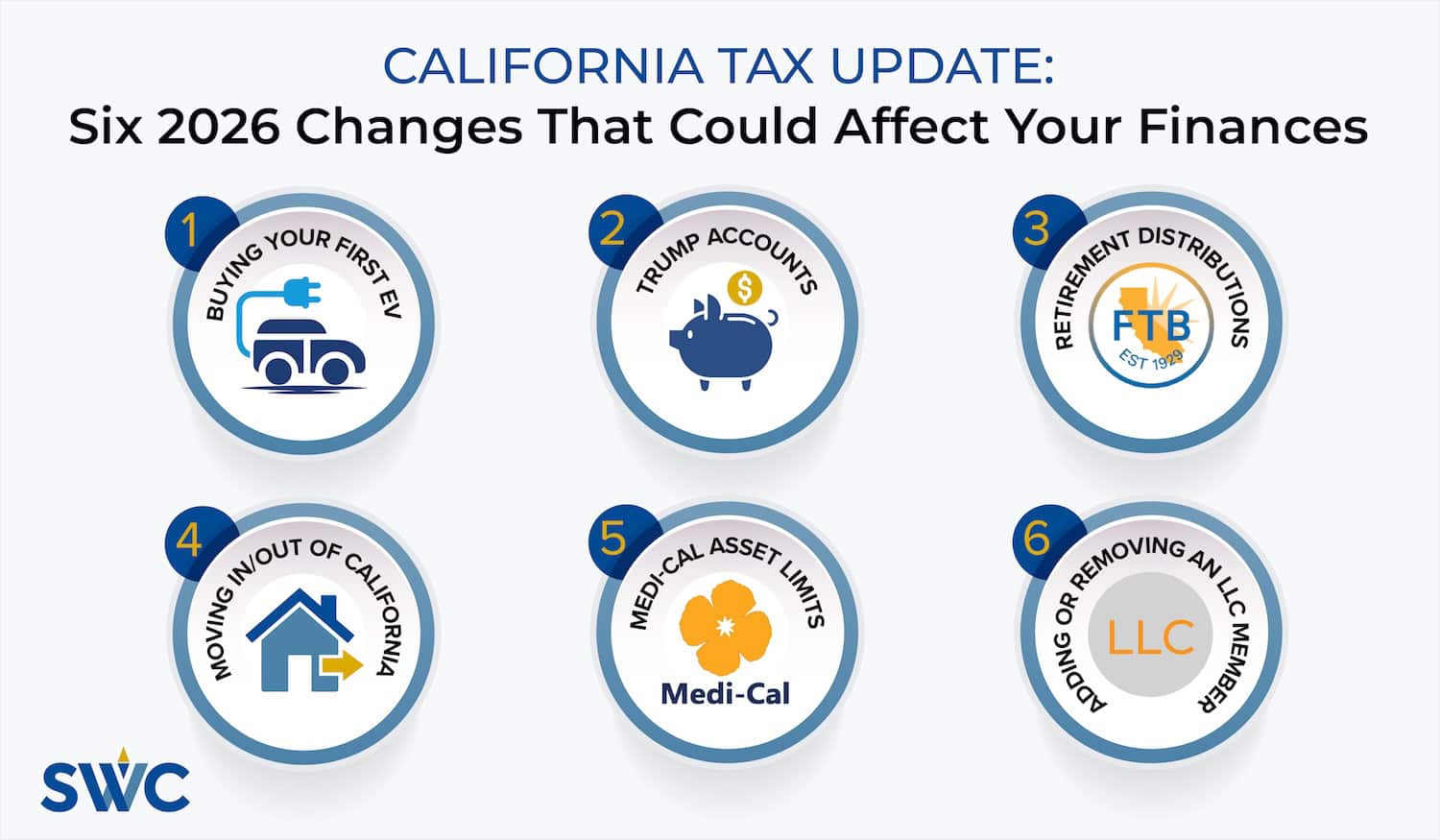
Here are six recent California developments we think deserve attention.
1. Buying Your First EV? California Has a New Rebate Coming
California’s new MyFirstEV program will provide an instant rebate for Californians buying or leasing their first qualifying zero-emission vehicle. The program offers $3,500 toward a qualifying new vehicle with a manufacturer’s suggested retail price of up to $50,000. Certain used vehicles sold for up to $25,000 through manufacturers’ pre-owned programs may qualify for a $1,750 rebate. The program does not impose an income limit on buyers.
The California Air Resources Board (ARB) oversees the program. As of our August 2026 review, California says the rebates will become available this fall, with further information about accessing the program still forthcoming.
That timing could matter if you’re already shopping for an EV. Eligibility also depends on the vehicle and participating manufacturer, so waiting for the final program details may affect your decision.
Thinking about buying or leasing an EV? Talk with us before completing the transaction. We can review the tax considerations in light of your individual circumstances and help you determine how available incentives may affect the economics of your purchase. Contact us: (858) 487-4580 or email admin@swc.cpa.
2. California Has Clarified Its Treatment of Trump Accounts
Trump Accounts are a new federal tax-advantaged account for eligible children. One question for California families has been whether California would follow the federal tax treatment of these accounts. (Read our post “Understanding Trump Accounts: Giving the Next Generation a Financial Head Start” for detailed information about this type of account.)
California has now addressed that uncertainty. Under legislation enacted as part of the state’s <!–more–>2026-27 budget package, The Golden State generally conforms to federal Trump Account taxation beginning with the 2026 tax year. Among the consequences described in the legislation, account earnings receive tax-deferred treatment until distributed, and California recognizes specified exclusions for qualifying employer, governmental, and charitable contributions.
While that makes the California tax treatment clearer, tax treatment represents only one consideration when deciding where to save for a child. Families may have other savings and investment options with different rules governing contributions, distributions, investment choices, and future use of the money.
Considering a Trump Account for your child? Ask us how the account could fit within your family’s existing tax and financial strategy. We can help you evaluate the account based on your family’s circumstances rather than the tax benefit alone.
3. Taking Retirement Distributions? Check Your California Tax Basis
Here’s an issue that can remain hidden for decades. California and federal law have not always treated retirement contributions the same way. As a result, some taxpayers may have a different California tax basis, generally the amount already subjected to California tax, in an IRA or another retirement account than they have for federal purposes.
California’s Franchise Tax Board (FTB) confirms that the taxable amount of a retirement distribution can differ when California and federal deductions differed.
Why does that matter? If California previously taxed money contributed to an account, overlooking that California basis when distributions begin could result in paying California income tax again on money previously taxed by the state.
This issue can arise from older contributions and certain differences between federal and California law. Residency changes can also affect the calculation.
If you’re taking retirement distributions, considering a Roth conversion, or preparing to begin withdrawals, we can review your retirement-account history. Our familiarity with your tax history may help us identify California basis or other tax considerations that could be missed when looking only at the current distribution.
4. Moving Into or Out of California? Timing Matters
California residency can affect far more than the address appearing on your tax return. (We covered this in-depth in Breaking Up Is Hard to Do: Ending Your California Residency.) California residents generally pay state income tax on income regardless of its source, while different sourcing rules apply to nonresidents and part-year residents.
A recent California tax appeal illustrates why the timing of a move and the timing of income can intersect.
In the case Appeal of J. Markham and M. Szpek, the taxpayers Markham and Szpek maintained a home in Washington but moved to California for the husband’s work shortly before receiving retirement distributions. The State of California ultimately treated them as residents when they received the distributions, resulting in more than $10,000 of additional tax plus interest.
Their case also demonstrates the importance of records showing when income was received and facts supporting the taxpayer’s residency position.
Warning: California distinguishes between “residence” and “domicile,” and whether someone’s presence or absence is temporary or transitory depends on the underlying facts.
Planning a move into or out of California around a significant income event? Talk with us before that move or transaction occurs (858-487-4580 or email admin@swc.cpa). We can review the timing within the context of your existing tax picture and identify documentation you may need while the facts are still easy to establish.
5. Medi-Cal Asset Limits Are Scheduled to Change
The State of California has also enacted a significant future change to Medi-Cal eligibility rules for certain residents.
According to the enacted changes covered in our August review, the nonexempt property limit will fall from its current $130,000 level to $21,000 for one person and $31,000 for a two-person household, with an additional amount for larger households. The change will take effect no earlier than July 1, 2027. The affected population can include certain people age 65 or older, people with disabilities, and nursing-home residents.
Medi-Cal eligibility involves rules beyond these asset amounts, so you should avoid treating the new thresholds as a stand-alone eligibility test. The appropriate response will depend on the individual’s circumstances and the rules in effect when eligibility becomes relevant.
If Medi-Cal may become part of planning for you or a family member, let us know. We can review the tax and financial considerations relevant to your circumstances and coordinate with your attorney or other professional advisors when the planning extends beyond our role.
6. Adding or Removing an LLC Member Can Trigger Unexpected Tax Consequences
For California business owners, changing LLC ownership can carry tax consequences that are easy to overlook.
A single-member LLC generally receives different federal tax treatment from an LLC with multiple members taxed as a partnership. California also requires single-member LLCs to file Form 568 (Limited Liability Company Return of Income) and generally subjects California LLCs to an $800 annual tax, with an additional LLC fee potentially applying based on California-source income.
When an LLC moves between single-member and multimember status, the transition can create short tax years and additional California filing and payment obligations. The August 2026 professional guidance we reviewed identifies circumstances in which two short-year California Forms 568, two $800 annual-tax payments, and potentially two LLC fees may result. The exact requirements depend on the LLC’s facts and tax classification.
Thinking about adding a business partner, buying out an existing member, or otherwise changing LLC ownership? Contact us before completing the transaction. Because we understand your business structure and broader tax situation, we can evaluate the tax and filing consequences before the ownership change takes effect.
We’re Here to Help
Each of these six developments involves a different part of tax planning or financial strategy, yet they share an important practical lesson: the headline rarely tells you how the rule applies to you.
If one of these changes touches a decision you’re considering, reach out to us before acting when possible. Understanding your tax history and financial circumstances allows us to move beyond explaining the rule and focus on how it may apply to your situation. Contact us to schedule a consultation: (858) 487-4580 or email admin@swc.cpa.
—————-
Disclaimer: The information in this SWC blog post is provided for general informational purposes only and may not reflect current financial thinking or practices. No information contained in this blog post should be construed as financial advice from the staff at SWC (Stees, Walker & Company, LLP), nor is this the information contained in this blog post intended to be a substitute for financial counsel on any subject matter or intended to take the place of hiring a Certified Public Accountant in your jurisdiction. No reader of this blog post should act or refrain from acting on the basis of any information included in, or accessible through, this blog post without seeking the appropriate financial planning advice on the particular facts and circumstances at issue from a licensed financial professional in the recipient’s state, country or other appropriate licensing jurisdiction.