

Welcome to Our Blog
We’re a San Diego, Calif.-based boutique tax consulting firm focused on personalized tax and financial guidance to individuals and businesses. Here on our blog, you’ll find you’ll find news, insights, and observations from trusted sources in the world of tax planning and and financial guidance.
Divorce and Social Security: What You Need to Know
Share This Post

Perhaps surprising to most people, California boasts among the lowest divorce rates in the nation, ranking seventh behind Illinois, New York, Minnesota, Alaska, New Jersey and Vermont.
Of course, that doesn’t mean Californians are immune from marital discord, discontent, or total breakdown. In fact, the most recent data from the U.S. Census Bureau’s American Community Survey shows that divorce rates are trending upward. Also eyebrow-raising? Nowhere is that truer than among those couples who are 50 years old and older. It’s so common now among that demographic that there’s even a term for it — “gray divorce,” which according to The Journals of Gerontology: Series B, accounts for 36 percent of all divorces in the United States.

If you or someone you know is age 50 or over, with a divorce on the horizon, or in progress, or that recently occurred, here’s what we want you to know about divorce and Social Security.
Divorce and Social Security
If you are divorced, it might benefit you financially to collect Social Security retirement or disability benefits based on your ex’s earnings instead of your own. For you to qualify, all of the following six conditions must be met:
- You’re 62 years or older.
- You were married to your ex-spouse for at least 10 years.
- You have been divorced from this ex-spouse for at least two years. (This condition applies only if you are claiming benefits before your ex-spouse has claimed benefits.)
- You aren’t currently married. (If you marry someone else, you cannot claim benefits based on your ex-spouse’s work record unless the new marriage ends in divorce, death, or annulment.)
- Your ex-spouse is currently entitled to receive Social Security retirement or disability benefits.
- Your benefit amount, based on your own earnings record, is not equal to or greater than half of your ex-spouse’s Social Security benefit.
After a divorce, you have a choice: Continue reading… Continue reading… Continue reading…
The Top 10 Reasons Why Business Owners Need to Meet With a CPA This Summer
Share This Post
A few days ago here on the SWC blog, we shared why it’s important for individual taxpayers to meet with their CPA over the summer. It basically boils down to being prepared. No one wants to learn in the first quarter of 2025 that their state or federal tax liability could have been dramatically reduced or altogether eliminated had they just met with their CPA for one hour in June, July, or August.
As a business owner, the same logic applies. Below are the top 10 reasons why you as a business owner, entrepreneur, or an investor with an ownership stake in a business should schedule a mid-year meeting with your CPA this summer.
- Take Advantage of Depreciation Tax Breaks: Current tax laws offer generous depreciation deductions for qualifying assets. By discussing your plans with us, we can help you maximize your Section 179 deductions and first-year bonus depreciation, potentially saving you significant amounts on your tax return.
- Time Business Income and Deductions: Strategically timing your business income and deductions can lead to substantial tax savings. Whether it’s deferring income or accelerating expenses, we’ll help you make the right moves to align with your financial goals.
- Maximize the Qualified Business Income (QBI) Deduction: The QBI deduction can be a significant tax saver for owners of pass-through entities. We’ll ensure you understand the complexities and limitations of this deduction, helping you plan to maximize your benefits.
The Top 10 Reasons to Ask Your CPA for a Mid-Year Meeting This Summer
Share This Post
Here at SWC, where we’re known as a leading independently owned tax planning and financial strategies advisory firm, we believe in empowering our clients with the tools and knowledge they need to make informed financial decisions.
Part of that approach is to offer a complimentary mid-year meeting that helps our clients navigate the complexities of tax planning, reduce their tax-related liabilities, and maximize their financial well-being.

If you’ve never heard of a mid-year meeting, it’s generally considered a preemptive move that allows you to discuss your financial situation with your CPA well before the end of the year when it’s often too late to implement strategies that can reduce your 2024 tax labilities.
Being on the fence about scheduling a mid-year tax meetings is understandable. After all, it’s summer, and who wants to be cooped up in a meeting with a CPA? But consider this: you have the ability to meet with us online — yes, even from your hotel room if you’re on vacation. Just pick a time slot that is available from now through the end of August. It’s only an hour of your time that likely will result in many hours of peaceful sleep before the end of the year.
With that in mind, here’s our top 10 reasons why you — the individual taxpayer — should schedule a mid-year meeting with your CPA this summer:
- Review and Adjust Your Withholding: A mid-year review of your withholding can ensure that you’re on track to meet your tax obligations without overpaying. Adjusting your withholding now can prevent surprises at tax time and help you manage your personal cash flow more effectively.
- Maximize Retirement Contributions: Reviewing your retirement contributions mid-year allows you to make necessary adjustments to maximize your savings. Whether it’s contributing to an IRA, 401(k), or
What You Need to Know About Reporting Beneficial Ownership Information
Share This Post
Editor’s Note (August 2026): Since this post was originally published, the federal government has changed the beneficial ownership information (BOI) reporting requirements under the Corporate Transparency Act. U.S.-formed companies are now exempt from BOI reporting requirements. The reporting rules generally apply only to certain entities formed under foreign law that are registered to do business in the United States. As a result, the BOI filing requirements described below no longer apply to U.S.-formed businesses. For additional details on the ruling, read the U.S. Department of Treasury’s Beneficial Ownership Information Reporting Requirement Revision (PDF file).
————
In 2021, the United States Congress passed the Corporate Transparency Act — a measure that creates a new beneficial ownership information reporting requirement. This requirement is part of the U.S. government’s efforts to make it harder for criminals, terrorists, and other bad actors to hide or benefit from their ill-gotten gains through shell companies or other opaque ownership structures.

Starting Jan. 1, 2024, many companies will be required to report information to the U.S. government — specifically to the Financial Crimes Enforcement Network (FinCEN) — about who owns and controls them directly or indirectly. FinCEN begins accepting beneficial ownership information (BOI) reports on Monday, Jan. 1, 2024, electronically through a secure filing system accessed through its website at www.fincen.gov/boi. However, the actual deadline for filing is based on the date of your company’s creation or registration to do business.
For example:
- A reporting company created or registered to do business before Jan. 1, 2024, has until Wednesday, Jan. 1, 2025, to file its initial beneficial ownership information report. (A reporting company is a business entity that’s required to report its beneficial ownership information; not all companies are required to do so. See the next section to determine whether your company is required to report its beneficial ownership information or not.)
- A reporting company established or registered between Jan. 1, 2024, and Jan. 1, 2025, must file its initial beneficial ownership information report within 90 calendar days after receiving notice of its creation or registration. This deadline of 90 calendar days commences upon the company’s receipt of official notice confirming its effective creation or registration, or following the initial public notice of the company’s creation or registration by a secretary of state or similar office, whichever occurs first.
- Companies subject to reporting, established or registered on or after Wednesday, Jan. 1, 2025, must submit their initial BOI (Beneficial Ownership Information) reports to FinCEN within 30 calendar days from the official confirmation or public announcement validating the effectiveness of the company’s creation or registration.
In this post, we bring you up to speed on what you need to know to comply with the requirement to report beneficial ownership information for any reporting companies you own or control; for example, if you operate your small business as an S-Corp or LLC. (Please note: The content of this blog post is not intended to serve as legal or financial advice. For more information, please refer to the Disclaimer at the end of this post.)
Warning! If you receive any correspondence claiming to be from a government agency instructing you to click a link or website address or scan a QR code to provide information about your company, disregard it. Such letters or email messages are fraudulent. Do not respond to them or click on any links or scan any QR codes they may contain. The Financial Crimes Enforcement Network (FinCEN) does not send unsolicited requests.
Determining Whether Your Company Is Required to Report Its Beneficial Ownership Information
There are two types of reporting companies (companies required to report beneficial ownership information): Continue reading… Continue reading… Continue reading…
IRS Issues Tax Inflation Adjustments for Tax Year 2024
Share This Post
Nobody likes paying more for something, but inflation does have its perks. For instance, you get to pay off debt with inflated dollars. And if you’re retired, you get annual cost of living adjustments (COLAs) reflected in your monthly Social Security payments. In addition, the Internal Revenue Service (IRS) helps to soothe the sting by making annual inflation adjustments.
These adjustments include changes to:
- Standard deduction amounts
- Marginal rates
- Personal exemptions
- Flexible Spending Accounts (FSAs)
- Medical Savings Accounts (MSAs)
- And more
The purpose of these adjustments is to help you avoid being pushed into a higher tax bracket or experience a reduction in the value of credits and deductions due to inflation.

Recently, the IRS announced its annual inflation adjustments for more than 60 tax provisions for tax year 2024, including the tax rate schedules and other tax changes. In this post, we highlight key changes that are likely to impact most taxpayers. (For more details, please see the IRS’s Revenue Procedure 2023-34.)
The tax year 2024 adjustments described below generally apply to income tax returns filed in 2025.
Standard Deduction
The standard deduction for tax year 2024 rises to: Continue reading… Continue reading… Continue reading…
How To Properly Document Your Charitable Contributions for Tax Purposes
Share This Post
Sometimes, it truly is better to give than to receive, especially when tax time rolls around and you’re looking for ways to reduce your reported income. The more generous you are, up to a point, the bigger your deduction, and the lower your tax obligation.
The drawbacks are few: You need to itemize your deductions instead of claiming the standard deduction, and you must document your charitable contributions. With the IRS gearing up to take a closer look at tax returns — especially those of high-income individuals — keeping detailed documentation is more important than ever.

In this post, we offer some general guidance on claiming deductions for charitable contributions. We also provide detailed guidance on how to document those contributions to maximize your tax benefits and get something back for your generous philanthropic efforts.
Choose Eligible Charities
The first step to claim deductions for charitable contributions is to donate to organizations that have a legitimate tax-exempt status. Only donations made to eligible nonprofit organizations, such as registered charities, religious organizations, educational institutions, and certain foundations, can be claimed as deductions on your tax return.
The IRS maintains a searchable database of qualified organizations on its website. Before donating to an organization, you can check to see whether it’s in the IRS database of tax-exempt organizations. Use the Internal Revenue Service’s (IRS’s) Tax-Exempt Organization Search tool at apps.irs.gov/app/eos.
Keep Detailed Records
Maintaining accurate records is essential when claiming deductions for charitable contributions.
Warning: When you donate, don’t forget to ask for a receipt or acknowledgment letter from the charity, which should include the charity’s name, the date of the donation, and the amount donated. These records are crucial when you file your tax return and need to prove your deductions.
Specific documentation requirements are as follows: Continue reading… Continue reading… Continue reading…
Complying with CalSavers — California’s Retirement Savings Mandate for Employers
Share This Post
As Southern California’s tax planning and financial strategies advisory firm for entrepreneurs and small business owners, we here at SWC play a unique role in helping our clients understand and comply with California’s tax laws and related regulations.
Small-business owners rarely have lawyers or lobbyists to represent them and keep them informed. Many small business owners aren’t even connected with resources like their local Chamber of Commerce. That’s where we come in. We are trusted tax professionals that our clients can turn to for information, guidance, and support.
And that includes notifications and updates related to CalSavers and California’s retirement savings mandate.
What Is CalSavers?

CalSavers is California’s retirement savings plan for workers whose employers don’t offer a workplace retirement plan, and for self-employed individuals and others who want to save extra toward retirement. Savers contribute to a Roth IRA (individual retirement account) that belongs to them but is administered by the state.
For a more detailed CalSavers primer, including how to register your business, please see our previous post, “Getting Up to Speed on CalSavers: California’s State-administered Retirement Plan.”
Designed to be easy for employers and simple for employees, CalSavers is professionally managed by private sector financial firms with oversight from a public board chaired by the State Treasurer. There are no fees for employers, and employees manage their accounts directly with CalSavers.
Employers that don’t offer their own plan must register with CalSavers by a specified deadline and facilitate their employee’s access to the program. And if they don’t? Well, that’s what the rest of this post is all about.
Is Your Business Required to Participate?
In 2023, the employer mandate was expanded to include employers with one (1) or more employees. Your business is exempt from participation in CalSavers in only three cases: Continue reading… Continue reading… Continue reading…
Designating Yourself a ‘Real Estate Professional’ and Claiming Real Estate Losses Against Ordinary Income
Share This Post
Welcome to the world of real estate, where savvy individuals who have earned the right to call themselves real estate investors have more options for taking advantage of tax-saving opportunities.
For those involved in the real estate industry, “materially participating” in the management of your properties or investments and being classified as a “real estate professional” can translate to substantial tax savings, leaving you with more cash to build your real estate investment portfolio.
In this post, we explore the distinct tax advantages that come with material participation and being recognized as a real estate professional, delving into how these designations can increase deductions, minimize tax liability, and ultimately enhance your financial portfolio of real estate investments.
Whether you’re a seasoned investor or a newcomer eager to optimize your tax planning, understanding and harnessing the potential of these classifications can accelerate your progress toward meeting your real estate investment goals and your overall financial goals.

Claiming Real Estate Losses Against Ordinary Income
As real estate investors know, rental real estate is ordinarily a “passive” activity. Generally, when you’re preparing your tax return, you can deduct passive losses only from passive income — income from sources such as stocks, mutual funds, royalties, and rental properties. You’re generally not allowed to deduct passive losses against ordinary income — income from sources such as salary and interest.
If all your income is passive, or if your passive gains exceed your passive losses, this restriction doesn’t impact your tax obligation. However, if your passive losses exceed your passive gains, and you have ordinary income, being able to claim passive losses against ordinary income can reduce your tax obligation.
There are two important exceptions that allow you to claim passive losses against ordinary income: Continue reading… Continue reading… Continue reading…
What You Need to Know About the Research and Development Tax Credit
Share This Post
When we initially meet with small business clients, they sometimes lament that the federal government isn’t as supportive of their contributions to society as they’d like. They envision a world where innovation not only fuels their business growth but also earns them a significant tax break.
As it turns out, in some respects, this is already a reality. The Credit For Increasing Research Activities (aka, the Research and Development (R&D) Tax Credit) — which first appeared as part of the Economic Tax Recovery Act of 1981 — is an often-overlooked tax incentive that serves as a powerful tool that may put money back into your business’ pocket for the inventive work you’re already doing. In this blog post, we share what you need to know to take advantage of this important tax credit.

If any part of your business involves designing, developing, or improving products, processes, formulas, or software, be sure you’re claiming a federal Research and Development (R&D) Tax Credit and any R&D tax credits your state may be offering to offset the costs of these activities. The federal benefit provides a dollar-for-dollar credit against your business tax for the costs of performing R&D activities.
Qualified expenses include:
- W2 wages paid to employees involved in the R&D activity
- Supplies (including tangible property, extraordinary utility costs, and server leasing costs) used for the R&D activity
- Contract R&D-related costs that would qualify if they were conducted by regular employees
Qualifying for the R&D Tax Credit: The Four Criteria
To qualify for the Research and Development (R&D) Tax Credit, your company’s R&D activities must be conducted within the United States and must meet all of the following four criteria: Continue reading… Continue reading… Continue reading…
The Pros and Cons of a Cost Segregation Study
Share This Post
If you own real estate, or you’re interested in investing in real estate as a strategy for building or increasing your net worth, then you need to know about cost segregation.
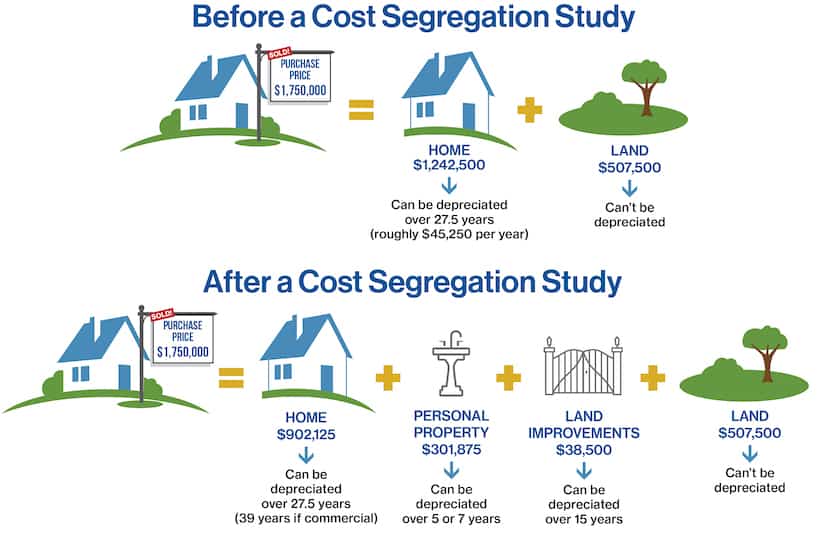 Cost segregation is a technique recommended by a tax planning firm that specialize in helping its clients reduce their taxes and increase their net worth. Cost segregation allows property owners and real estate investors to reallocate the costs of a property from long-term assets (which have a useful life of 27.5 years or more) to shorter-lived assets (which have a useful life of less than 27.5 years).
This reallocation can provide significant tax benefits because shorter-lived assets are eligible for accelerated depreciation.
Depreciation 101: Depreciation is an accounting technique that distributes the cost of tangible assets such as real estate over their useful lifespan. It reflects the portion of an asset’s value that’s been utilized, allowing you to gradually pay for and generate revenue from an asset over a specified period of time.
When a property is built or purchased, the costs of the property (such as construction costs or the purchase price and cost of improvements) are typically allocated to the building and land as long-term assets. However, many of the items within a property (such as carpeting, lighting fixtures, and appliances) have a shorter useful life and can be classified as personal property. By identifying these shorter-lived assets and reclassifying them as personal property, the costs associated with them can be depreciated over a shorter period, resulting in a larger tax deduction in the early years of ownership.
Starting With a Cost Segregation Study
To add cost segregation to your tax planning approach, start by ordering a cost segregation study from a reputable firm. Here at SWC, we work with several of these firms and can recommend the right one for your particular circumstances and objectives.
When you engage a firm in a cost segregation study, a cost segregation specialist identifies and reclassifies the costs of your property, typically by examining the property and its invoices, blueprints, and other documentation. The study then allocates property costs to real property or personal property. Findings from the study can then be used by your tax planning firm — in this case, SWC — to calculate a one-time catch- adjustment. That’s because the IRS allows the Continue reading… Continue reading… Continue reading…