

Welcome to Our Blog
We’re a San Diego, Calif.-based boutique tax consulting firm focused on personalized tax and financial guidance to individuals and businesses. Here on our blog, you’ll find you’ll find news, insights, and observations from trusted sources in the world of tax planning and and financial guidance.
Demystifying the Inflation Reduction Act: Part 4 — Additional Provisions
Share This Post

The Inflation Reduction Act of 2022 (IRA ’22) is 750-plus pages of tax and spending legislation designed to tackle everything from climate change to the runaway costs of prescription medication. It contains tax credits for clean energy, nuclear power production, electric vehicles, and other technologies intended to fuel the transition to a lower carbon economy.
It also seeks to reduce health insurance premiums for 13 million low- and middle-income Americans and imposes a $2,000 per year cap on out-of-pocket medicine costs under Medicare Part D. And it establishes a new 15 percent minimum tax on the “book income” of large corporations.
Oh, and if you believe the stated intent, it provides about $80 billion in new funding to the IRS over the next 10 years that is not exclusively for increased tax enforcement. More on this below.

We covered many of the provisions of the new legislation, which the President signed into law on Aug. 16, 2022, in the first three parts of this four-part series:
- Part 1: The Clean Vehicle Tax Credit
- Part 2: Energy Efficiency Credits and Rebates for Residents and Owners of Residential Property
- Part 3: Tax Implications for Businesses and Corporations
Today’s Part 4 of this series covers additional provisions in the IRA ’22 that apply to increased IRS funding, drug pricing, and Affordable Care Act insurance premiums.
Increased IRS Funding
The Internal Revenue Service (IRS) has been underfunded for years. You may have experienced the ramifications of this underfunding if you ever tried to contact the IRS with a question or concern. But the lack of funding has also impaired the IRS’s ability to conduct audits and collect unpaid taxes.
The Inflation Reduction Act of 2022 provides an additional $80 billion to the IRS over 10 years to improve customer services and expand its enforcement and compliance efforts. The Congressional Budget Office estimates that these investments will raise an additional $124 billion from increased collections over a 10-year period.
Perhaps the most controversial aspect of this increased funding is what the IRS plans to do with it — hire and train up to 87,000 new IRS agents. While U.S. Secretary of the Treasury Janet Yellen has indicated that the additional funds will not be used to increase audits of people earning less than $400,000, it would be foolish to believe that such an increase in enforcement efforts would not be used to target regular, everyday taxpayers.
Warning: As soon as the IRS uses the increased funding to become fully staffed, we are confident that it will expand its enforcement efforts to small businesses and households making less than $400,000 per year.
Your best defense is Continue reading… Continue reading… Continue reading…
Demystifying the Inflation Reduction Act: Part 3 — Tax Implications for Businesses and Corporations
Share This Post
The Inflation Reduction Act of 2022 (IRA ’22) is generally considered to be ‘Build Back Better Light’ (note: we briefly covered the President’s ‘Build Back Better’ proposal in 2021 Year-End Tax-planning Tips for Business Owners here on the SWC blog.). Many of its provisions are clearly intended to offset the costs of transitioning to green energy for consumers, as explained in Part 1 and Part 2 of this four-part series.
However, the IRA ’22 also contains several provisions that apply specifically to businesses and corporations — some of which provide similar incentives for adopting green energy alternatives and others which clearly target businesses and corporations to increase tax revenue — presumably to help cover the cost of this Act.
In this, Part 3 of our series, we get down to business as we highlight what business owners and corporate leaders need to know about the IRA ’22.

Green Energy Tax Incentives: Extended and Revised
Many of the energy credits available to businesses before the enactment of the Inflation Reduction Act of 2022 have been extended and revised by the Act. Below are highlights of some of the changes made to existing business energy credits and incentives:
- Revises the Internal Revenue Code (IRC) §179D Energy Efficient Commercial Buildings deduction as follows:
- The deduction is increased for taxpayers who meet specified prevailing wage and apprenticeship requirements (see below) and decreased for taxpayers who do not. (For additional information on prevailing wages, visit the U.S. Department of Labor’s prevailing wages webpage.)
- Allows additional increases for achieving specified energy savings targets.
- Replaces the lifetime cap on the deduction with a three-year cap.
- Updates the efficiency standards that must be met.
- Allows tax-exempt entities, including governmental agencies, to allocate the deduction to the designer of the building or the qualified retrofit plan.
- Modifies the Renewable Electricity Production Credit in the following ways: Continue reading… Continue reading… Continue reading…
Demystifying the Inflation Reduction Act: Part 2 — Energy Efficiency Credits and Rebates for Residents and Owners of Residential Property
Share This Post
The Inflation Reduction Act of 2022 (IRA ’22) has garnered a great deal of press, along with even more confusion and concern. Its provisions cover everything from offsetting the costs of the transition to green energy to helping consumers keep pace with the rising costs of health insurance and prescription medications.
To help you make sense of this massive piece of legislation, we are breaking it all down in this four-part series — “Demystifying the Inflation Reduction Act.”
Last week, we posted Part 1 of this series to explain the Clean Vehicle Credit — a tax credit intended to help offset the cost of certain new and used electric vehicles and electric hybrids.
- Here, in Part 2 of this series, we stay with the theme of green energy by examining tax incentives and rebates intended to help residents and owners of residential property make their homes more energy efficient.
- In Part 3, we shift our attention to provisions in the Act that apply to businesses.
- And we wrap the series in Part 4 by covering a hodgepodge of other provisions, including tax incentives to help make healthcare more affordable and increased funding for the IRS.
The Residential Clean Energy Credit
In the Inflation Reduction Act of 2022, the Residential Energy Efficient Property Credit under Internal Revenue Code §25D (often referred to as the Solar Energy Credit) is renamed the “Residential Clean Energy Credit” and is extended to property placed in service prior to January 1, 2035.
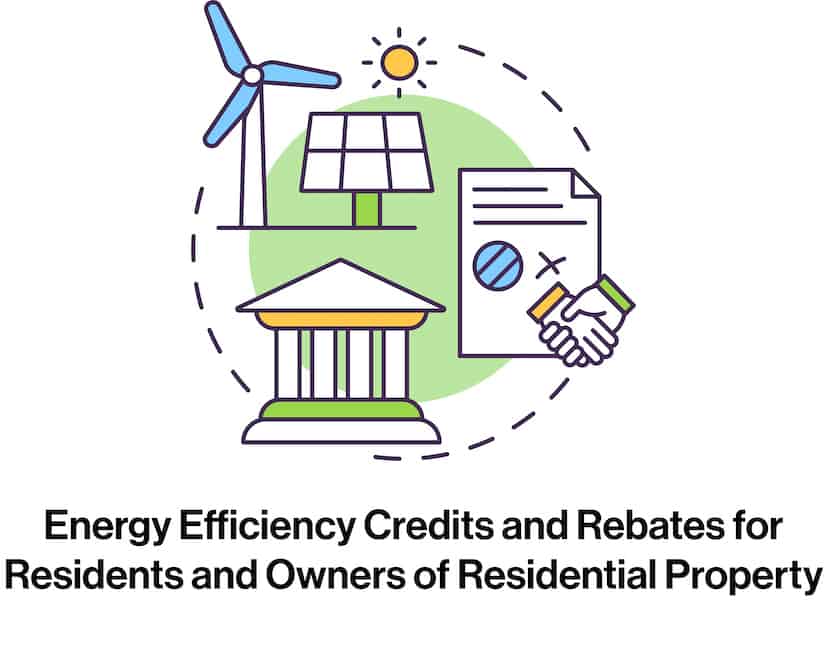 Prior to passage of the Inflation Reduction Act, homeowners were entitled to a non-refundable tax credit for the use of solar electric panels, solar hot water heaters, fuel cells, small wind energy systems, geothermal heat pumps, and biomass fuel units they had installed for their homes.
That credit was in the process of being gradually reduced and then eliminated by the end of 2023. The Inflation Reduction Act retroactively returns the credit to 30 percent for the years 2022 through 2032 when it begins to phase out again and end after 2034. Those who qualify for the credit in 2022 receive a 30 percent credit rather than the expected 26 percent.
Electrifying: The Act’s battery storage technology is also added to the list of qualified expenditures eligible for the renamed credit and is applicable to expenditures made after December 31, 2022.
The Energy Efficient Home Improvement Credit
The Energy Efficient Home Improvement Credit essentially renames and modifies the Internal Revenue Code’s §25C Nonbusiness Energy Credit and extends it to apply to purchases of qualified property placed in service prior to January 1, 2033.
Notable changes introduced by the Energy Efficient Home Improvement Credit include the following and apply to property placed in service after December 31, 2022 and through December 31, 2032: Continue reading… Continue reading… Continue reading…
Demystifying the Inflation Reduction Act: Part 1 — The Clean Vehicle Tax Credit
Share This Post
Regardless of whether you approve of the most recent spending bill out of Washington D.C. or think that “Inflation Reduction Act” is a misnomer, now that it has been passed by Congress and signed by the President, it is law.
The best approach at this point for both individual and corporate taxpayers is to take advantage of the tax incentives that the legislation provides and identify the most effective ways to deal with new challenges presented by the legislation, such as the $80 million in additional funding for the Internal Revenue Service (IRS).
In this four-part series, “Demystifying the Inflation Reduction Act,” we highlight the key provisions in this bill that are likely to impact individuals, businesses, and corporations now and for years to come:
- In this part, we cover the Clean Vehicle Credit for individual taxpayers.
- In Part 2, we cover tax credits and rebates for offsetting the costs of making your home more energy efficient.
- In Part 3, we focus our attention on various provisions in the bill that will impact businesses and corporations.
- In Part 4, we cover other provisions in the bill, including tax incentives to help make healthcare more affordable and increased funding being allocated to the IRS.
Clean Vehicle Credit

The Act’s Clean Vehicle Credit replaces the current Qualified Plug-in Electric Drive Motor Vehicle Credit. It’s generally applicable to qualified electric vehicles, including plug-in hybrid electric vehicles (PHEVs) and hydrogen fuel cell electric vehicles (FCEVs) placed in service starting in 2023 through 2032. (PHEVs typically operate on electricity until the battery is depleted, at which point they run on gas. FCEVs are typically powered by hydrogen fuel cells.)
Key changes introduced in the Clean Vehicle Credit include but are not limited to the following: Continue reading… Continue reading… Continue reading…
Keeping Pace with California Tax Law: Part 3 — Property Tax Relief for the Elderly and Disabled
Share This Post
Welcome to the final part of our three-part series on keeping pace with California tax law. In Part 1 of this series, we covered Prop 19, which makes it more affordable for older California homeowners to relocate within the state. In Part 2, we explained changes to the parent-child exclusion, which enables children to inherit their parent’s property and parents to inherit their children’s property without a property tax increase, subject to certain qualifications and limitations.
In this part, we bring you up to speed on additional California state-sponsored property tax relief programs for helping senior citizens on limited income and those who are legally blind or disabled. Specifically, we’re going to cover the following:
- The Property Tax Postponement Program, which is supported by the State of California Controller’s Office
- The Property Tax Assistance Program, which is supported by the California State Franchise Tax Board (suspended for now due to lack of funds)

Pro Tip: The inserts mailed along with your annual tax bill contain details about any property tax relief programs currently available, so be sure to read those inserts carefully to determine whether you qualify for any currently available programs.
The Property Tax Postponement Program
The State of California’s Property Tax Postponement Program (PTP) allows homeowners who are seniors, are blind, or have a disability, to defer current-year property taxes on their principal residence if they meet certain criteria, including the following: Continue reading… Continue reading… Continue reading…
Keeping Pace with California Tax Law: Part 2 — The Parent-Child Exclusion
Share This Post
This week, in Part 2 of our three-part series on keeping pace with California tax law, we bring you up to speed on the parent-child exclusion, which applies to any real property purchases or transfers between parents and children. In last week’s post, we covered Prop 19, which makes it more affordable for older homeowners to relocate in California.
In a nutshell, the parent-child exclusion enables children to inherit their parents’ property and parents to inherit their children’s property without a property tax increase, subject to certain qualifications and limitations. Prop 19 changed the way the parent-child exclusion works as of Feb. 16, 2021.

The Parent-Child Exclusion Before and After Prop 19
In California, real property, such as a home, is reassessed only upon a change in ownership, but when the change in ownership is within a family — specifically parent to child, child to parent, or grandparent to grandchildren — you can file for a reassessment exclusion to prevent a reassessment or reduce the reassessed value.
Before Prop 19 (effective Feb. 16, 2021), here’s how the parent-child exclusion worked:
- Parents (transferor) could transfer their primary residence to their child/children (transferees) without a reassessment.
- There was no limit on the value of the home that could be transferred.
- The child/children could live in the home, use it as a vacation home, or rent it out.
- Parents could transfer up to $1 million of California real property other than their primary residence to a child/children without reassessment. If the assessed value is more than $1 million, the first million dollars is transferred without change, and only the balance is reassessed.
Prop 19 changed the rules. For any property transfers occurring on or after Feb. 16, 2021, the parent-child exclusion works like this: Continue reading… Continue reading… Continue reading…
Keeping Pace with California Tax Law: Part 1 — Understanding Prop 19
Share This Post
Nobody can accuse California legislators of being lazy when it comes to tax legislation. They’re constantly introducing new legislation, which often presents opportunities for taxpayers to reduce their tax liability. And whether you agree with their approach or feel such relief is a poor use of taxpayer funds, staying on top of these relief measures only benefits you and the things you care about.
As one of California’s premier tax and financial strategy firms, we keep a close eye on changes to federal, state, and local tax code, so that we can fine-tune each of our client’s personalized tax-savings and wealth-building plans.

In this three-part series, we discuss three recent changes to California tax code that may impact your taxes (hopefully in a good way):
- Prop 19, which makes it more affordable for older homeowners to relocate in California
- The Parent-Child Exclusion, which applies to the purchase or transfer of a principal residence between parents and children
- Property tax relief for the elderly and disabled
Understanding Prop 19
Prop 19 — The Home Protection for Seniors, Severely Disabled, Families, and Victims of Wildfire or Natural Disasters Act — is intended to help retirees and older homeowners sell their primary residence and relocate within California more affordably. Starting April 1, 2021, eligible California homeowners could sell their primary residence and transfer the tax base from their previous home to their next home of equal or lesser value.
For example, suppose you’ve owned a home in San Diego for the last 20 years and its assessed value is Continue reading… Continue reading… Continue reading…
Tax Relief for California Taxpayers
Share This Post
The California State Assembly — the lower house of the California State Legislature — recently passed legislation to offer inflation relief to California residents who filed their 2020 taxes along with addition tax-relief legislation. In this post, we touch on the key points of the new legislation.
Better for Families (Inflation Relief) Tax Refund
California Assembly Bill No. 192 establishes what is commonly referred to as the “Inflation Relief Tax Refund.” This bill authorizes a one-time tax refund of up to $1,050 for married filing jointly (MFJ) taxpayers with California Adjusted Gross Income (AGI) of up to $500,000 with a dependent and up to $700 payment for qualifying individual taxpayers with California AGI of up to $250,000 with a dependent.

Payments will be distributed starting late October (the earliest) with the last batch expected to be sent by the middle of January 2023.
To qualify to receive the refund, you must meet the following criteria:
- Filed your 2020 tax return by October 15, 2021. If you didn’t file your 2020 tax return by this date, you’re not eligible for the refund. However, if you applied for an Individual Taxpayer Identification Number (ITIN) and had not received it by October 15, 2021, you must have filed your complete 2020 tax return by February 15, 2022.
- Have a 2020 California adjusted gross income (AGI) of $500,000 or less (married filing jointly or head of household) or $250,000 or less (single filer)
- Have been a California resident for six months or more of the 2020 tax year
- Have not been eligible to be claimed as a dependent in the 2020 tax year
- Are a California resident on the date the payment is issued
If you qualify, you will receive a direct deposit payment (if you filed your return electronically and indicated direct deposit on your tax return); otherwise, you’ll receive payment in the form of a debit card.
The payment amount you can expect depends on your adjusted gross income (AGI): Continue reading… Continue reading… Continue reading…
Do You Need a Title Lock Service?
Share This Post
Many companies these days are promoting title lock services, claiming to offer protection against scammers who commit title fraud — a crime that involves fraudulently transferring a property title or deed from the rightful owners to the scammer.
Sadly, committing title fraud is easy — the scammer simply forges or tricks the owners of the property into signing a quit claim deed or other document to relinquish ownership of the property. The scammer files the document with the county clerk to record a change of ownership — to the scammer. The scammer can then try to evict the rightful owners, claim ownership of the property for themselves, and then sell it or (more commonly) borrow money against the home and leave the homeowners and lender to battle over the mortgage payments.
Scary, yes, but does a title lock service provide sufficient protection to warrant its cost? In this post, we explain what a title lock service is and help you decide whether it’s something you want to spend money on.
What Is a Title Lock Service?
First things first — a title lock service doesn’t lock your title. It doesn’t prevent someone from filing a quit claim deed or using some other method to fraudulently claim that you transferred ownership of your property to them. All it does is notify you, after the fact, when someone succeeds in filing a document that shows a transfer of ownership. It’s sort of like when you receive a notification from an online service that someone changed the username, password, or contact information for your account and letting you know that if you didn’t do it, then something suspicious is going on, and you need to look into it.
Many counties in the U.S. are starting to offer this same service for free. All you need to do, in most cases, is fill out a form to register for the service, provide proof of identity, list the properties you own that you want to be notified about, and specify your preferred contact information — email address, phone number, or mailing address. Whenever someone tries to transfer ownership of your property or change the name on the deed, the county notifies you, so that you can take legal action to protect what’s yours.
Title Insurance Versus a Title Lock
Don’t confuse title insurance with a title lock. Title insurance is a Continue reading… Continue reading… Continue reading…
Alert: IRS Increases Mileage Rate to 62.5 Cents Per Mile
Share This Post
Gas prices have risen, on average, about $2 per gallon since this time last year. In response, the Internal Revenue Service (IRS) has increased the standard mileage deduction for businesses 4 cents a mile starting July 1, 2022 — from 58.5 cents to 62.5 cents per mile.
Likewise, the new rate for deductible medical or moving expenses (available for active-duty members of the military) will be 22 cents for the remainder of 2022 — up 4 cents from the rate effective at the start of 2022. (The 14-cent per mile rate for charitable organizations remains unchanged because it’s set by statute.)

An increase of only 4 cents a mile might seem like a pittance, but when you do the math, it adds up. For example, if you drive a vehicle that gets 20 miles a gallon, 4 cents a mile results in a deduction of 80 cents per gallon.
Of course, that still doesn’t come close to covering the extra $2 per gallon you’re paying at the pump, not to mention all the other rising costs of owning and maintaining a vehicle for your business. You know, things like lease payments (or depreciation), license and registration, insurance, maintenance, and repairs.
Here’s a thought. Have you considered halting your habit of taking the easy way out (using the standard mileage deduction) and instead start keeping detailed records of all the actual costs of owning and operating the vehicle?
Understanding Your Options: Actual Expenses vs. Standard Mileage
That’s right. The IRS gives you two ways to calculate your business vehicle deduction: Continue reading… Continue reading… Continue reading…