
Summer 2026 Tax Updates Business Owners, Investors & California Taxpayers Should Know

Summer may feel like a quiet time for tax planning, especially after the spring filing rush. In reality, some of the most important tax planning windows open midyear, when business owners, real estate investors, individuals, and families still have time to make informed decisions before the end of the year.

This summer, several federal tax updates deserve attention. Some involve deadlines. Others are focused on Internal Revenue Service (IRS) account access, digital assets, qualified small business stock (QSBS), Health Savings Accounts (HSAs), disaster relief, and Employee Retention Credit claims (refundable tax credits for businesses and non-profits that kept employees on their payroll during pandemic-related government shutdowns or significant revenue declines). And for California taxpayers, the state’s Franchise Tax Board (FTB) identity verification notices deserve a closer look.
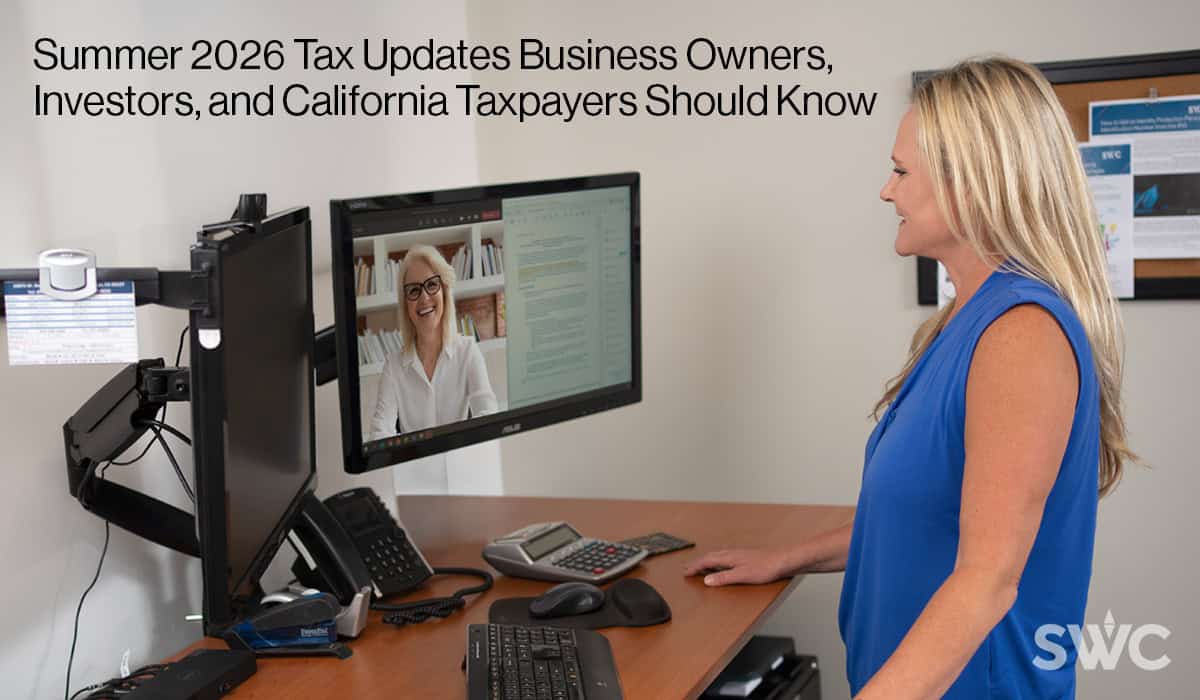
In this post, we explain what has changed, who may be affected, and what steps you may need to take before the next tax season catches you by surprise. First up, summer deadlines.

Summer 2026 Tax Deadlines for Individuals and Business Owners

Two July deadlines stand out for taxpayers and business owners.

First, July 6, 2026, marks the deadline for certain Section 174 elections tied to research and experimental expenditures. These rules may matter for businesses with software development, product development, engineering, scientific research, or other innovation-related costs.

Second, July 10, 2026, marks an extended deadline tied to possible COVID-era refund claims for penalties and interest. This deadline stems from litigation involving whether certain filing and payment deadlines received automatic disaster-related postponement during the COVID-19 disaster period (Jan. 20, 2021 – July 10, 2023).

Here’s what that means in plain English: Some taxpayers who paid penalties or interest connected to COVID-era filing or payment timing may have a potential refund claim. The rules remain technical, and the IRS may challenge claims depending on the facts, so it’s best to ask about this during your Summer 2026 Mid-Year Tax Appointment with us here at SWC.

IRS Business Tax Account Access: What Business Owners Should Review in Summer 2026

The IRS has continued to expand online access for business taxpayers. For S corporations and C corporations, certain individuals, known as Designated Officials, can use the IRS Business Tax Account to view information such as Continue reading… Continue reading… Continue reading…

Avoid Costly Mistakes with Pass-Through Entity Tax Payments

If you use the State of California’s Franchise Tax Board (FTB) website to make an electronic payment for an elective pass-through entity, you should know ahead of time that it’s easy to make a mistake and get mixed up over personal and business payments.

Here at SWC, a San Diego-based tax planning and financial strategy firm for entrepreneurs and small business owners, real estate investors, and high-net-worth individuals, we see this happening all too often. And that’s why in this post, we explain how California’s version of the elective pass-through entity tax works and provide guidance on how to avoid making costly mistakes when paying your elective tax.

Graphic for Pass Thru Entity Tax Payments

To start us off, if you’re unfamiliar with the elective pass-through entity tax, here’s what we want you to know.

Understanding the Elective Pass-Through Entity Tax

The Tax Cuts and Jobs Act (TCJA), which some have described as “the most sweeping tax overhaul in decades,” was signed into law on Dec. 22, 2017, just 50 days after it was first introduced in the U.S. House of Representative. Once enacted on Jan. 1, 2018, the TCJA limited the amount of state and local taxes (income taxes, sales taxes, and property taxes) that taxpayers are allowed to deduct when filing their federal income tax returns. This resulted in the cap being $10,000 for married couples and $5,000 for individuals (or married individuals who choose to file separately).

For example, suppose you’re a married couple living in California, and you paid $7,000 in state income taxes and $6,000 in property taxes. That’s $13,000 total. Under the TCJA, when you’re filing your federal income tax return, you would be able to deduct only $10,000 from your taxable income, not the full $13,000.

Understanding that this cap could be especially burdensome for taxpayers in states with high income taxes and/or high property taxes, some states, such as California, enacted an elective pass-through entity tax as a workaround. In California, this workaround is detailed in California Assembly Bill 150 — the Sales and Use Tax Law: Personal Income Tax Law: Corporation Tax Law: Budget Act of 2021.

A pass-through entity (PTE) is a legal business structure wherein income flows through to the business entity’s owners and investors, rendering the income of the entity as the income of the owners or investors. Pass-through entities include sole-proprietorships, limited liability companies (LLCs), partnerships, and S-corporations.

How California Elective Pass-Through Entity (PTE) Tax Works

California’s elective pass-through entity (PTE) tax isn’t very complicated, and here’s how it works: Continue reading… Continue reading… Continue reading…

Go to Top
